The Backbone of Blockchain Networks Explained Simply
“If blockchain is a city, nodes are the citizens who keep it running.”
Blockchain works without a central authority. But how? The answer is nodes.
Let’s understand what nodes and masternodes are, their history, why they matter, and how they are used.
What Is a Node?
A node is a computer connected to a blockchain network that:
Stores a copy of the blockchain
Verifies transactions
Communicates with other computers
👉 In simple words: A node is a participant computer in the blockchain system.
Technical Definition
A node is a device running blockchain protocol software that participates in validating, relaying, and maintaining the distributed ledger by communicating with other peer nodes in the network.
Nodes follow consensus rules such as:
Proof of Work (PoW)
Proof of Stake (PoS)
Who Invented Nodes?
Nodes were not invented separately — they come from Peer-to-Peer (P2P) networking concepts.
P2P networks existed since the 1990s
Blockchain nodes were introduced by Satoshi Nakamoto in 2008 with Bitcoin
Timeline of Nodes in Blockchain
Year
Event
1990s
Peer-to-peer networking develops
2008
Bitcoin whitepaper introduces blockchain nodes
2009
Bitcoin network launches with nodes
2014
Masternode concept gains popularity
2015–2022
Nodes expand in PoS networks
Today
Nodes power thousands of blockchain systems
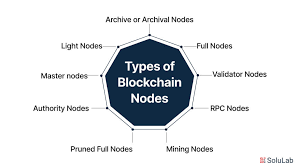
Types of Nodes
Type
Role
Full Node
Stores full blockchain and validates transactions
Light Node
Stores limited data
Mining Node
Competes to create blocks (PoW)
Validator Node
Validates blocks (PoS)
Masternode
Special node with extra features
What Is a Masternode?
A masternode is a special type of full node that:
Requires locking a certain number of coins
Performs additional functions
Receives rewards
👉 Think of it as a senior node with extra responsibilities.
Technical Definition of Masternode
A masternode is a collateral-backed full node that provides advanced network services such as governance voting, instant transactions, and private transactions while earning rewards.
Example: Bitcoin has thousands of nodes worldwide.
Node vs Masternode Comparison
Feature
Node
Masternode
Basic Network Participation
Yes
Yes
Requires Collateral
No
Yes
Governance Voting
No
Yes
Earn Rewards
Sometimes
Yes
Advanced Services
No
Yes
Opinion
Nodes are the foundation of blockchain decentralization. Masternodes are the advanced operators that enhance performance and governance.
The Backbone of Blockchain Networks Explained Simply
“If blockchain is a city, nodes are the citizens who keep it running.”
Blockchain works without a central authority. But how? The answer is nodes.
Let’s understand what nodes and masternodes are, their history, why they matter, and how they are used.
What Is a Node?
A node is a computer connected to a blockchain network that:
Stores a copy of the blockchain
Verifies transactions
Communicates with other computers
👉 In simple words: A node is a participant computer in the blockchain system.
Technical Definition
A node is a device running blockchain protocol software that participates in validating, relaying, and maintaining the distributed ledger by communicating with other peer nodes in the network.
Nodes follow consensus rules such as:
Proof of Work (PoW)
Proof of Stake (PoS)
Who Invented Nodes?
Nodes were not invented separately — they come from Peer-to-Peer (P2P) networking concepts.
P2P networks existed since the 1990s
Blockchain nodes were introduced by Satoshi Nakamoto in 2008 with Bitcoin
Timeline of Nodes in Blockchain
Year
Event
1990s
Peer-to-peer networking develops
2008
Bitcoin whitepaper introduces blockchain nodes
2009
Bitcoin network launches with nodes
2014
Masternode concept gains popularity
2015–2022
Nodes expand in PoS networks
Today
Nodes power thousands of blockchain systems
Types of Nodes
Type
Role
Full Node
Stores full blockchain and validates transactions
Light Node
Stores limited data
Mining Node
Competes to create blocks (PoW)
Validator Node
Validates blocks (PoS)
Masternode
Special node with extra features
What Is a Masternode?
A masternode is a special type of full node that:
Requires locking a certain number of coins
Performs additional functions
Receives rewards
👉 Think of it as a senior node with extra responsibilities.
Technical Definition of Masternode
A masternode is a collateral-backed full node that provides advanced network services such as governance voting, instant transactions, and private transactions while earning rewards.