
How a simple idea to make digital payments private evolved into Bitcoin and changed the way the world thinks about money.
Imagine a world where you could send money to someone on the other side of the world without handing over cash, visiting a bank, or relying on a traditional payment system. Today, digital payments and cryptocurrencies make this idea familiar. But the journey began decades before Bitcoin.
The history of digital currency is not just the story of Bitcoin. It is a story of privacy, technology, experimentation, and the search for a better way to transfer value.
Let’s explore the important milestones in simple language.
1. The beginning: How did digital currency start?
Before Bitcoin existed, researchers and entrepreneurs were already exploring ways to make money work electronically.
The key challenge was this: How can people pay digitally while protecting privacy, preventing fraud, and ensuring that the same digital money cannot be spent twice?
Different projects tried to solve different parts of this problem. Some relied on companies and central systems, while others explored ways to create digital money without depending on a central authority.
2. The timeline: From 1983 to 2009

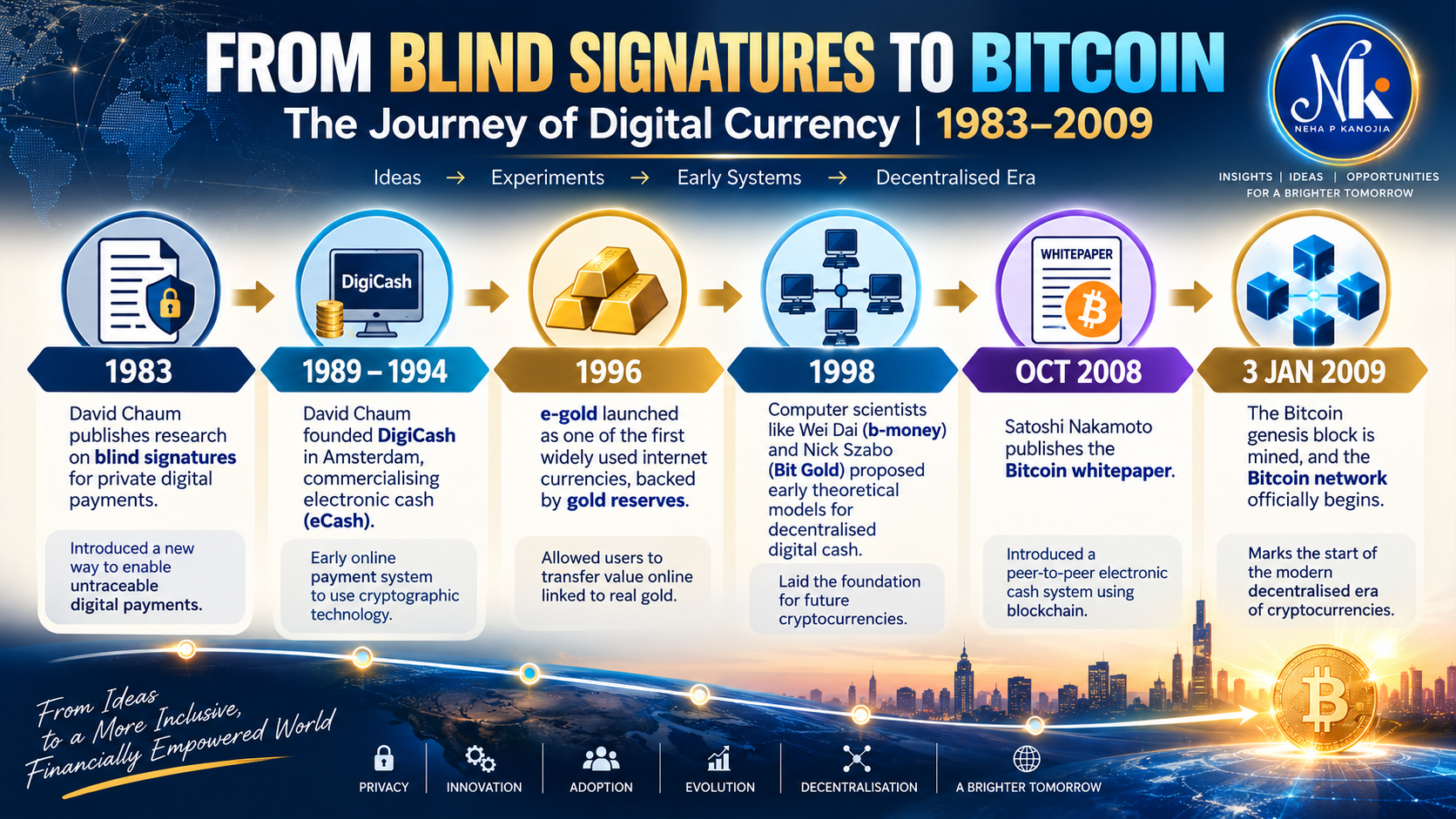
1983 — The idea of private digital cash
The pioneer: David Chaum
Chaum published research on blind signatures, a cryptographic technique that allows a digital document to be signed without the signer seeing its contents. This helped lay the groundwork for privacy-preserving electronic payments.
CiNii Research
Simple example: Imagine a bank validating a digital note without being able to link that note to the person who later spends it.

1989–1994 — DigiCash and eCash
Chaum founded DigiCash to turn his research into a working payment system. By 1994, DigiCash was demonstrating electronic cash payments over computer networks. The system offered privacy, but it still relied on participating banks to issue the digital money.
chaum.com
Simple example: Digital cash on a computer that you could use at a participating online shop.

1996 — e-gold
Digital currency linked to gold
e-gold allowed users to transfer value represented by gold held in reserve. Unlike Bitcoin, it depended on a central operator and physical gold backing. Its history later ended amid U.S. legal action.
Wikipedia
Simple example: Sending someone a digital claim representing a quantity of gold.

1998 — Ideas for decentralised digital money
Researchers proposed concepts such as b-money, associated with Wei Dai, and Bit Gold, proposed by Nick Szabo. These ideas explored ways to create digital value using cryptography and distributed systems without relying entirely on one central issuer. They were important precursors, not fully launched currencies like Bitcoin.
Wikipedia
Simple example: A digital money system where a network, rather than a single company, helps establish and verify ownership.

October 2008 — The Bitcoin whitepaper
An author using the name Satoshi Nakamoto published Bitcoin: A Peer-to-Peer Electronic Cash System. It proposed online payments directly between users, using a peer-to-peer network and proof of work to address the problem of spending the same digital coins more than once.
The Bitcoin Paper
Simple example: Instead of depending on one central company to maintain the transaction record, computers across the network help validate it.

3 January 2009 — Bitcoin goes live
The first Bitcoin block, known as the genesis block, was mined. This marked the start of the Bitcoin blockchain and its public transaction history.
Open source P2P money
Simple example: The network began building a shared record of Bitcoin transactions, block by block.
3. Understanding the difference: Electronic money vs cryptocurrency
Not all digital money is cryptocurrency. The most important distinction is who issues the money and who controls the transaction record.
| Feature | Early eCash | e-gold | Bitcoin |
|---|---|---|---|
| First major milestone | Chaum’s 1983 research; practical system in the 1990s | 1996 | Whitepaper in 2008; network in 2009 |
| What gave it value? | Bank-issued digital cash | Gold held in reserve | Market demand and the Bitcoin protocol |
| Central authority? | Yes, participating banks | Yes, central operator | No single central issuer |
| Blockchain? | No Bitcoin-style blockchain | No Bitcoin-style blockchain | Yes |
| Main idea | Payment privacy | Digital transfer of gold-linked value | Peer-to-peer digital currency |
| Key limitation | Needed banks and merchant adoption | Depended on the operator and backing | Price volatility, technical risks and adoption challenges |
The key lesson: digital currency existed before blockchain-based cryptocurrency. Bitcoin’s major innovation was combining cryptography, peer-to-peer networking and proof of work into a system that could maintain a shared transaction history without one central operator.
4. Three concepts that changed digital money
Cryptography — protecting information
Cryptography uses mathematical techniques to protect information and verify authenticity. It helps digital payments remain secure and helps users prove ownership of digital assets.
Centralised systems — relying on an operator
Early systems such as eCash relied on participating banks to issue and validate digital money. Users depended on those institutions to keep the system running.
Decentralisation — sharing responsibility
Bitcoin introduced a system in which independent computers participate in validating transactions and maintaining a shared record, rather than relying on one central operator.
The Bitcoin Paper
5. Why did Bitcoin become such an important milestone?
Earlier digital-currency projects showed that money could move electronically, and cryptography could help protect privacy. However, many still depended on a central company or bank.
Bitcoin brought several ideas together:
- Peer-to-peer transfers: users can send Bitcoin directly across the network.
- A shared transaction record: transactions are organised into blocks linked together in a blockchain.
- Proof of work: computers compete to add new blocks according to the protocol’s rules.
- A solution to double-spending: the network uses a shared history and consensus rules to make it difficult to spend the same Bitcoin twice.
Bitcoin was not the beginning of digital money. It was a major milestone in the development of decentralised digital currency.
The Bitcoin Paper
6. What happened after 2009?
The years after Bitcoin saw the development of many more cryptocurrencies, blockchain platforms, stablecoins and central bank digital currency projects. Each follows a different model, with different approaches to governance, value, privacy and regulation.
It is important to distinguish them:
| Type | Simple explanation |
|---|---|
| Digital payments | Electronic transfers of money, often through bank accounts |
| Cryptocurrency | A digital asset that uses cryptography and typically operates on a blockchain or similar network |
| Stablecoin | A crypto token designed to maintain a relatively stable value, often by referencing a currency |
| CBDC | Digital money issued by a central bank, such as India’s digital rupee |
These are related developments, but they are not interchangeable.
Final thoughts: From an idea to a global technology
The journey from David Chaum’s blind-signature research in 1983 to Bitcoin’s launch in 2009 took more than 25 years. Along the way, innovators explored privacy, gold-backed digital value, electronic payments and decentralised networks.
The lesson is simple: today’s digital financial systems were built on decades of experimentation. Understanding that history helps us understand why blockchain matters—and why the future of money may include several different technologies working side by side.
“The future of money is not just about moving value digitally; it is about deciding how that value is protected, verified and trusted.”