
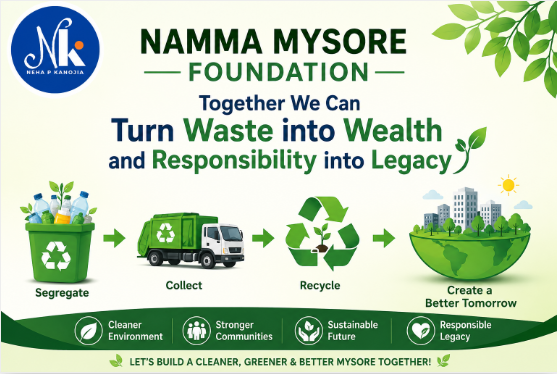
A vision for sustainable urban development, responsible infrastructure, and a future where technology protects both people and the environment.
Hyderabad is growing. Its IT corridors are expanding, traffic congestion is increasing, and the need for faster, smarter public transport is becoming more urgent. But as we plan the cities of tomorrow, we must ask an equally important question:
Can we build modern infrastructure without creating another environmental burden for future generations?
A recent newspaper report about Hyderabad’s proposed Personal Rapid Transit (PRT) system presents an opportunity to think beyond transportation. It is an opportunity to bring together smart mobility, scientific waste management, recycled construction materials, and environmental responsibility.
The vision should not be limited to moving people faster. It should also be about creating a city where people can breathe cleaner air, enjoy healthier surroundings, and live with less pollution.
1. What does the newspaper report say about Hyderabad’s podcar project?
According to the newspaper clipping shared, the Telangana government is planning a proposed 34-kilometre Personal Rapid Transit system to improve connectivity in congested areas of Hyderabad. Chief Minister A. Revanth Reddy has reportedly given preliminary approval to three corridors.

Proposed transport corridors
- Raidurg–Kukatpally
- HITEC City–Raidurg
- Kondapur–Financial District

How the system is expected to work
- Automated, driverless electric podcars
- Approximately six passengers per pod
- Dedicated tracks, around 4.5 metres wide
- Designed to provide last-mile connectivity to Metro Rail
The report also mentions a projected ridership of 20 lakh by 2050, estimated construction costs of ₹80–100 crore per kilometre, and an overall project cost of approximately ₹3,400 crore. The final deployment details are yet to be settled, according to the clipping.
These figures are reported proposals and estimates, not confirmation that construction is complete or that the entire system is operational.
The project could be an important step in improving urban mobility. But large infrastructure projects also create an opportunity to plan environmental protection from the very beginning.
2. A smart city needs more than smart transport
An elevated podcar system may improve last-mile connectivity and help commuters reach workplaces more conveniently. But every major infrastructure project also creates environmental responsibilities.
Construction can generate concrete debris, steel scrap, packaging, and other construction and demolition (C&D) waste. Once the system becomes operational, stations and surrounding commercial areas will generate everyday waste, including plastic bottles, food packaging, and disposable cups.
If these issues are not planned for early, tomorrow’s smart transport infrastructure could coexist with tomorrow’s overflowing waste sites.
| Urban challenge | Smart solution to consider |
|---|---|
| Construction and demolition debris | Waste audits, authorised collection, reuse and responsible processing |
| Plastic bottles and food wrappers | Segregation at stations and commercial premises |
| Mixed waste from offices and malls | On-site segregation and organised collection |
| Untracked waste movement | Digital weighing, tracking and processing records |
| Public littering | Awareness campaigns, clear signage and convenient bins |
| Environmental accountability | Regular reporting and measurable waste-diversion targets |
Our suggestion: Environmental management should be included in the planning and tendering stages of major infrastructure projects—not treated as an afterthought.
3. How Namma Mysore Foundation and Jagruth Tech can contribute
Two organisations with complementary capabilities could help infrastructure developers, government departments, commercial establishments, and communities develop practical waste-management solutions.

Namma Mysore Foundation (NMF)
NMF works on integrated waste management, waste audits, source segregation, community awareness, digital waste tracking, and sustainability reporting. Its Zero Waste Programme serves organisations such as corporate offices, educational institutions, industrial townships, and hospitality businesses.
Namma Mysore Foundation (R)
+1
Website: Namma Mysore Foundation – Zero Waste Programme

Jagruth Tech Pvt. Ltd.
Jagruth Tech focuses on collecting and upcycling low-value plastic into useful products, including eco-interlock pavers, kerb stones, grass pavers, tiles, and saucer drains. Its website describes its role in plastic recovery and its collaboration with NMF on waste awareness and circular-economy initiatives.
jagruthtech.com
+1
Website: Jagruth Tech
Together, their capabilities could support a more integrated approach: NMF helps organise and track waste management, while Jagruth Tech offers pathways for upcycling suitable low-value plastic into useful products. The precise materials accepted, processing requirements, technical specifications, and environmental performance should be assessed for each project.
4. Five practical ways to make Hyderabad’s project greener
- Conduct a waste audit before construction begins. Identify the types and quantities of waste expected from construction sites, station areas, offices, and nearby commercial establishments.
- Build segregation into the design. Provide clearly labelled bins and practical collection systems at stations and associated public spaces.
- Create a responsible plastic recovery chain. Route suitable plastic to authorised processors and recyclers. Evaluate whether products made from recovered plastic can be used in appropriate non-critical applications, subject to engineering and safety standards.
- Track every stage. Use digital records to document waste quantities, collection, transportation, and final processing destinations. NMF describes WASTRAQ™ as a platform for waste tracking and sustainability reporting.
Namma Mysore Foundation (R)+1
- Make citizens part of the project. Run awareness programmes for commuters, students, office employees, shopkeepers, and residents. Infrastructure works better when people understand how to use it responsibly.
5. Why should the government and project developers consider this collaboration?
The proposed podcar project is an opportunity to integrate environmental responsibility into urban development from the beginning.
| Potential benefit | What it could achieve |
|---|---|
| Better waste management | Less uncontrolled dumping and littering |
| Resource recovery | More suitable materials returned to productive use |
| Digital traceability | Clearer records of where waste goes |
| Community participation | Better segregation and cleaner public spaces |
| Sustainability reporting | Evidence of waste reduction and processing |
| Local livelihood opportunities | Potential work in collection, sorting, awareness, and processing |
These benefits depend on implementation, appropriate approvals, measurable outcomes, and reliable operating arrangements. A partnership should set clear targets and verify results rather than assume that every waste stream can be recycled.
6. Our appeal to the Telangana Government and infrastructure developers
Hyderabad is thinking about the future of transportation. Let us also think about the future of the environment in which that transportation will operate.
We respectfully encourage the Telangana Government, Hyderabad Metro Rail Limited, infrastructure developers, CSR partners, and commercial establishments to explore collaboration with Namma Mysore Foundation and Jagruth Tech Pvt. Ltd. for suitable waste-management and plastic-recovery initiatives.
A possible starting point would be a defined pilot covering a construction site, a station area, or a participating commercial campus. The partners could assess the waste generated, establish segregation and collection systems, track the material flow, and report verified results before considering wider implementation.
This would allow the project team to test what works, measure costs and environmental outcomes, and make informed decisions about scaling up.
The bigger vision: Smart infrastructure, responsible citizens
A truly smart city is not defined only by automated transport, modern buildings, or digital technology.
It is also defined by how responsibly it manages the resources it consumes and the waste it produces.
Let us build transport systems that connect people, waste systems that recover resources, and communities that understand their responsibility towards the environment.
Hyderabad deserves modern mobility. Its people also deserve clean air, safe water, healthy soil, and a city their children can be proud to inherit.
“Let us not build a smarter city while leaving behind a bigger waste problem. Let us build a city where progress and environmental responsibility move forward together.”