
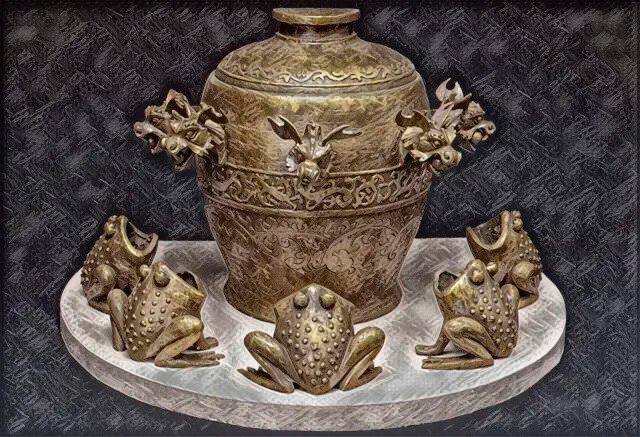
More than 1,800 years ago, long before satellites, sensors, or digital monitors ever existed, ancient China created a device so brilliant, so artistic, and so scientifically advanced that even modern engineers still marvel at it today.
What you see in the image is not just a bronze vessel —
It is the world’s first seismograph, born in 132 A.D. during the Han Dynasty.
A time when science and art blended so gracefully that even a natural disaster like an earthquake could be felt, interpreted, and announced through the mouths of dragons and frogs.
🐲 A Vessel of Dragons, Frogs, and Extraordinary Genius
At first glance, the device looks like a beautifully crafted bronze jar.
But look closer…
- Around the body of the jar are eight imperial dragons, each holding a metal ball in its mouth.
- Beneath them sit eight frogs, mouths wide open, patiently waiting.
Each dragon-frog pair represents a direction —
North, South, East, West, and the four diagonals.
This was no decoration.
This was ancient engineering at its peak.
⚡ How This Magical Device Worked ..
Inside the vessel, a brilliant but simple mechanism lay hidden — a kind of pendulum that could shift even with faint ground vibrations.
Here’s what happened during an earthquake:
- The Earth trembles.
- The internal pendulum tilts — even if people cannot feel anything.
- The tilting triggers one dragon’s mouth to open.
- The dragon drops a bronze ball into the corresponding frog’s mouth.
- CLINK! — A clear metallic sound announces the direction of the quake.
Imagine hearing that sound in ancient times —
People would look at the frog, see the fallen ball, and instantly know:
“The earthquake came from the East.”
This wasn’t just detection.
It was direction.
Centuries ahead of its time.
👑 The Genius Behind the Invention: Zhang Heng
This masterpiece was created by Zhang Heng, a Chinese polymath:
- Astronomer
- Mathematician
- Inventor
- Cartographer
- Engineer
- Poet
- Philosopher
His mind worked at a level where art, science, and intuition merged.
He didn’t have modern instruments or electronics.
He had logic.
He had observation.
He had imagination.
And with that, he built a device that astonished the emperor —
because it detected a distant earthquake that people in the capital did not even feel.
Only later did messengers confirm:
“An earthquake has struck west of the capital.”
Zhang Heng had proven his brilliance.
🌏 Why This Invention Still Matters Today
We live in a world of:
✔ Digital sensors
✔ Seismic waves
✔ Geological maps
✔ Early warning systems
Yet the core idea remains the same:
The Earth speaks through vibrations — and our tools must learn to listen.
This ancient Chinese seismograph reminds us:
- Innovation existed long before modern technology
- Engineering does not always need complexity
- Beauty and science can live in the same object
- Human curiosity is timeless
In a way, Zhang Heng’s creation is not just a scientific device —
It is a philosophical message:
When we pay attention, the world speaks.
🌟 My Opinion
I find this invention deeply inspiring.
It shows that human creativity and problem-solving are not limited by time or tools.
Even in 132 A.D., with no electricity, no computers, and no modern machinery, people created something so elegant and powerful that it still surprises us today.
To me, this seismograph is more than an artifact —
It is a reminder that innovation begins with observation, imagination, and the courage to try.
A bronze jar with dragons and frogs…
Yet capable of hearing the Earth itself.
Absolutely fascinating.