
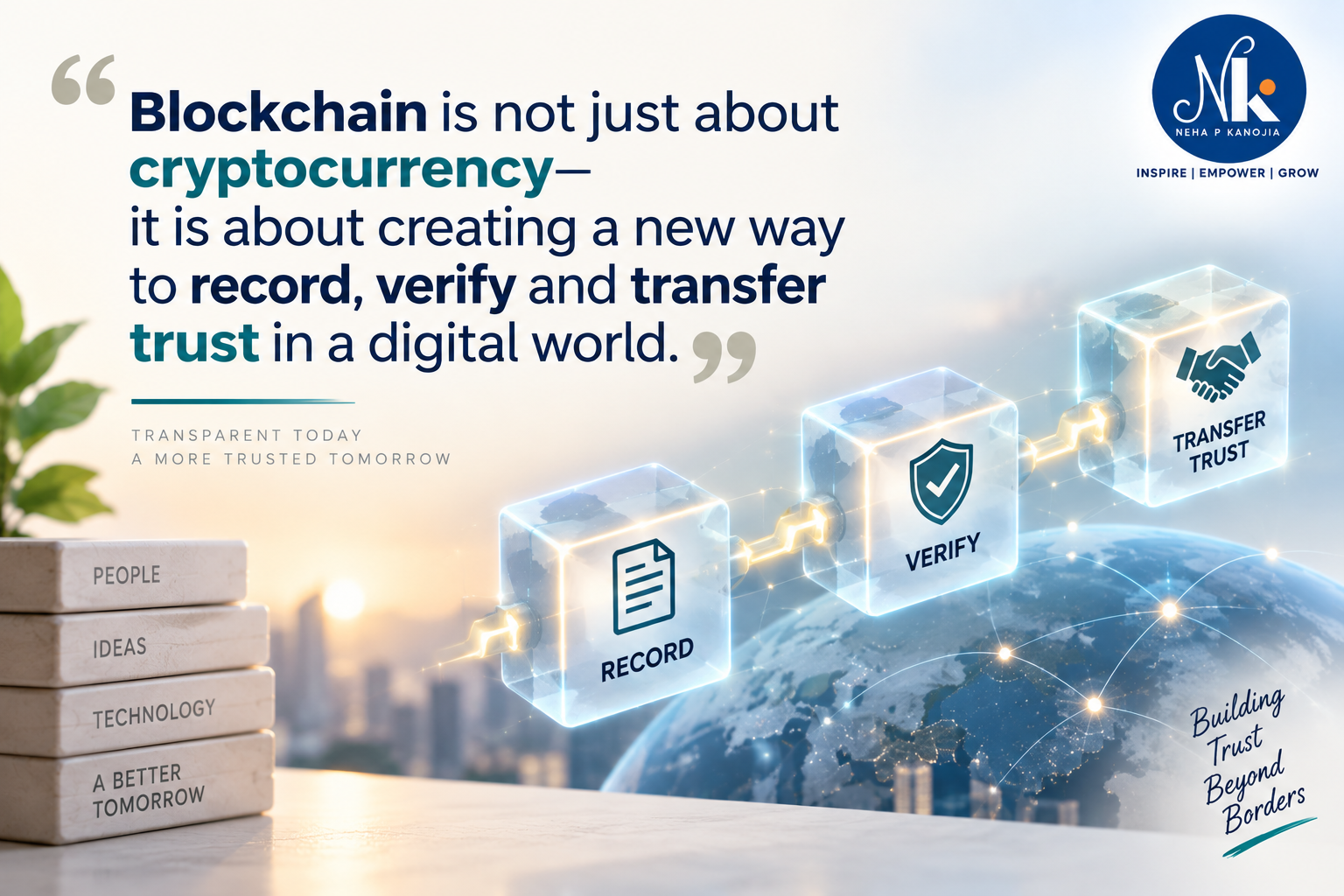
“Blockchain is not just about cryptocurrency—it is about creating a new way to record, verify and transfer trust in a digital world.”
When people hear Blockchain, the first word that usually comes to mind is Bitcoin.
But blockchain is much bigger than Bitcoin.
Bitcoin uses blockchain, but blockchain can also be used for payments, banking, supply chains, digital identity, healthcare records, tokenized assets, smart contracts, trade, and many other applications.
In simple words:
Blockchain is a shared digital record book that allows information or transactions to be recorded, verified and connected in a way that makes unauthorized changes extremely difficult.
The U.S. National Institute of Standards and Technology (NIST) describes blockchain as a distributed, tamper-evident and tamper-resistant digital ledger whose records are grouped into blocks and cryptographically linked together.
Let’s understand blockchain from zero to advanced concepts—using simple, everyday examples.
1. What Is Blockchain?
Let’s forget the complicated technical definitions for a moment.
Imagine a large notebook.
Every time someone makes a transaction, it is written in that notebook.
For example:
Neha sends ₹1,000 to Priya.
The transaction is recorded.
Now imagine that instead of one person keeping the notebook, thousands of computers have copies of the same record.
If a new transaction is added, the network checks whether it is valid.
Once accepted, the transaction becomes part of the shared record.
That is the basic idea behind blockchain.
Blockchain = Shared + Digital + Distributed + Cryptographically Linked Record
NIST explains that blockchain records are grouped into blocks, and each block is cryptographically linked to the previous block.
2. Why Is It Called “Blockchain”?
The answer is actually very simple.
A blockchain consists of:
Block + Block + Block + Block
Each block contains information, such as transactions.
The blocks are connected using cryptographic techniques.
Think of it like a train:
🚂 Block 1 → Block 2 → Block 3 → Block 4 → Block 5
If someone tries to secretly change an earlier block, the cryptographic connections reveal that something has changed.
That’s why blockchain is designed to be tamper-evident and tamper-resistant.
3. Who Invented Blockchain?
This question has an important answer:
Blockchain does not have one single inventor.
The technology developed over several decades.
There were important ideas before Bitcoin.
1980s — Early Foundations
Researchers explored ways to create digital systems that could establish trust between parties who might not completely trust each other.
David Chaum’s earlier work is part of the broader history of cryptographic and digital-cash systems.
4. 1991 — Stuart Haber and W. Scott Stornetta
A major milestone came in 1991.
Researchers Stuart Haber and W. Scott Stornetta proposed a cryptographic method for creating a secure timestamping system for digital documents.
Their goal was important:
How can we prove that a digital document existed at a particular time without allowing someone to secretly change its history?
They used cryptographic techniques to link records together.
This was an important foundation for what later became blockchain technology.
So, if someone asks:
“Who first developed the core idea of cryptographically linked records?”
Haber and Stornetta are among the most important names to remember.
5. 2008 — Satoshi Nakamoto Changes the Game
Then came a major breakthrough.
In 2008, an individual or group using the name Satoshi Nakamoto published the Bitcoin whitepaper:
“Bitcoin: A Peer-to-Peer Electronic Cash System.”
The paper was published on October 31, 2008.
Satoshi combined several existing technologies and ideas into a practical system designed to allow people to transfer digital value without relying on a central financial institution to maintain the transaction ledger.
The key problem was:
How can digital money be transferred without someone spending the same digital money twice?
This is called the:
Double-Spending Problem
6. Why Was Blockchain Invented?
The answer is not simply:
“To create Bitcoin.”
The deeper purpose was to solve a trust and record-keeping problem.
In traditional finance, imagine I send ₹1,000 to you.
A bank or payment company maintains the official record.
Traditional system:
You → Bank → Record → Me
The institution acts as the trusted intermediary.
But Bitcoin’s design asked:
Can a network of computers maintain the record collectively instead of relying on one central institution?
Satoshi’s 2008 proposal used a peer-to-peer network, cryptographic signatures, hashing and proof-of-work to create a shared transaction history and address double spending.
7. The Real Problem Blockchain Was Trying to Solve
Imagine you have a digital ₹1,000.
Unlike a physical ₹1,000 note, a digital file can potentially be copied.
So what stops someone from saying:
“I have ₹1,000.”
and then sending the same ₹1,000 to five different people?
A centralized system solves this by maintaining a trusted database.
Blockchain explored another approach:
Let the network collectively verify the transaction history.
That was a major technological shift.
8. How Does Blockchain Work?
Let’s use a simple example.
Suppose:
Transaction 1
Amit → ₹500 → Neha
Transaction 2
Neha → ₹200 → Rahul
Transaction 3
Rahul → ₹100 → Priya
These transactions are collected into a block.
Step 1 — Transactions Are Created
Users initiate transactions.
↓
Step 2 — Transactions Are Broadcast
Transactions are shared with network participants.
↓
Step 3 — Transactions Are Verified
The network checks whether the transactions follow the rules.
↓
Step 4 — Transactions Are Grouped
Valid transactions can be assembled into a block.
↓
Step 5 — Consensus Happens
The network uses its consensus mechanism to agree on which block should be added.
↓
Step 6 — Block Is Added
The new block becomes part of the blockchain.
↓
Step 7 — Network Updates
Participants update their copies or relevant records.
This creates a continuously growing digital history.
9. What Is Inside a Block?
A simplified block can contain:
| Component | Simple Meaning |
|---|---|
| Transactions | Records of activity |
| Timestamp | When the block was created |
| Block reference/hash | Digital fingerprint connecting it to previous data |
| Validation information | Information used by the network’s consensus mechanism |
| Other metadata | Additional information depending on the blockchain |
The exact structure varies from one blockchain to another.
10. What Is a Hash?
A hash is like a digital fingerprint.
Imagine you have a document.
A hashing algorithm processes that document and produces a unique-looking string.
Document
“Neha sends 1 Bitcoin to Priya.”
↓
Hash
A7F9…XYZ
If the original information changes, the resulting hash also changes.
This helps blockchains detect changes to previously recorded information.
NIST identifies cryptographic hashing as one of the core technologies used in blockchain systems.
11. Why Is Blockchain Difficult to Change?
This is one of blockchain’s most important characteristics.
Imagine:
Block 1 → Block 2 → Block 3 → Block 4
Each block is linked to the previous one.
Now someone tries to secretly change information in Block 2.
That changes its cryptographic fingerprint.
The connection to Block 3 no longer matches.
Then the chain after it is affected.
Therefore, altering historical records can require overcoming the blockchain’s validation and consensus mechanisms.
This is why blockchain is often described as tamper-resistant, rather than magically “impossible to change.”
NIST specifically uses the terms tamper-evident and tamper-resistant.
12. What Does “Distributed” Mean?
This word sounds complicated, but it is simple.
Centralized system:
One main database
Everyone depends on that central system.
Distributed system:
Many participating computers/nodes maintain or verify copies of the ledger according to the network’s rules.
This can improve resilience and reduce dependence on one central database.
NIST describes blockchain as a distributed ledger rather than a single central repository.
13. What Is a Node?
A node is a computer participating in a blockchain network.
Depending on the blockchain, different nodes can perform different functions.
They may:
- Store blockchain data
- Verify transactions
- Relay information
- Participate in consensus
- Help maintain the network
Think of nodes as:
The computers helping maintain the digital record book.
14. What Is Consensus?
If thousands of computers are maintaining a shared ledger, an important question appears:
Who decides which transaction or block is valid?
The answer is:
Consensus mechanism
Consensus is the process through which network participants agree on the valid state of the blockchain.
Different blockchains use different approaches.
Two famous examples are:
Proof of Work
and
Proof of Stake
NIST identifies consensus mechanisms as a fundamental part of blockchain systems.
15. Proof of Work — PoW
Proof of Work is the mechanism used by Bitcoin.
In simple language:
Computers compete to solve a computational puzzle.
The successful participant gets the right to propose a block under the network’s rules.
The process requires computational resources.
Bitcoin’s original design used proof-of-work as part of its mechanism for building the blockchain and addressing double spending.
Simple example:
Imagine 1,000 people are trying to solve a difficult mathematical puzzle.
The first valid solution wins the opportunity to add the next block.
This requires computing power and electricity.
16. Proof of Stake — PoS
Proof of Stake works differently.
Instead of relying primarily on computational competition, participants can help secure the network by staking the network’s native assets, subject to the blockchain’s rules.
Validators are selected according to the protocol to help propose and/or attest to blocks.
If validators violate the rules, they may face penalties depending on the system.
Simple comparison:
Proof of Work → Computing power
Proof of Stake → Staked economic value
Different PoS blockchains have different designs, so the exact mechanism varies.
17. Types of Blockchain
Blockchain networks can be classified in different ways.
One of the most useful ways is according to who is allowed to participate and maintain the network.
NIST broadly distinguishes:
- Permissionless blockchains
- Permissioned blockchains
Permissioned systems can then be organized in different governance models, including private and consortium arrangements.
For beginners, it is useful to understand four common categories:
1. Public Blockchain
2. Private Blockchain
3. Consortium Blockchain
4. Hybrid Blockchain
Let’s understand each.
18. Type 1 — Public Blockchain
A public blockchain is generally open for participation.
Anyone who meets the protocol’s rules can potentially:
- Join the network
- Submit transactions
- Verify information
- Participate in consensus, depending on the blockchain
Examples include:
Bitcoin
Ethereum
Public blockchains are often permissionless.
NIST describes permissionless networks as networks where participants do not need authorization from a central authority to participate in publishing blocks.
Advantages
- Open participation
- Transparency
- Global accessibility
- Strong decentralization potential
- No single organization necessarily controls the network
Challenges
- Scalability
- Transaction costs
- Privacy
- Governance complexity
- Energy consumption for some consensus models
19. Type 2 — Private Blockchain
A private blockchain is controlled by a specific organization or authorized group.
Imagine a large company wants a blockchain for its internal operations.
Only approved participants can access or maintain it.
Example:
A company could use a private blockchain to track:
Supplier → Factory → Warehouse → Distribution → Retailer
The company controls who participates.
Advantages
- Greater control
- Faster processing can be possible
- Better privacy
- Known participants
Disadvantages
- More centralized
- Less open
- Trust may still depend heavily on the organization controlling the system
20. Type 3 — Consortium Blockchain
A consortium blockchain is controlled by multiple organizations, rather than one organization.
Imagine:
5 banks
decide to operate a shared blockchain.
Instead of:
Bank A controls everything
you have:
Bank A + Bank B + Bank C + Bank D + Bank E
working under agreed rules.
This can be useful when multiple organizations need a shared record but do not want one company to control the entire system.
NIST notes that permissioned blockchain networks are often deployed among groups of organizations or individuals, commonly described as consortia.
21. Type 4 — Hybrid Blockchain
A hybrid blockchain combines elements of public and private systems.
For example:
Some information might remain private.
Other information could be publicly verifiable.
Imagine a healthcare organization.
Private:
Patient medical details
Public/verifiable:
A proof that a particular record existed and was not altered.
This type of architecture can be useful when organizations need both:
Privacy + Verification
The exact design varies widely by implementation.
22. Public vs Private vs Consortium vs Hybrid
| Type | Who Can Participate? | Main Benefit | Common Use |
|---|---|---|---|
| Public | Broad/open participation | Decentralization & transparency | Crypto |
| Private | Authorized participants | Control & privacy | Enterprise |
| Consortium | Selected organizations | Shared control | Banking/supply chain |
| Hybrid | Combination | Balance of privacy & transparency | Enterprise/public verification |
Important: These labels can overlap with another classification—permissionless vs permissioned. They are not always perfectly interchangeable terms. NIST specifically frames blockchain access around the permission model.
23. Blockchain Is Not the Same as Bitcoin
This is one of the biggest misunderstandings.
Bitcoin = Digital asset/network
Blockchain = Technology used to record Bitcoin transactions
Think of:
and
Internet
The internet is the infrastructure.
Email is one application that uses it.
Similarly:
Blockchain → Technology
Bitcoin → One major application/network using blockchain
NIST describes blockchain as the underlying technology for many cryptocurrency systems while also noting broader applications.
24. Blockchain in Our Everyday Life
You may already be living in a world where blockchain is becoming relevant—even if you never personally buy cryptocurrency.
Let’s look at some examples.
1. Banking
Blockchain and distributed-ledger technology can be used to explore:
- Faster settlement
- Cross-border transactions
- Digital assets
- Securities settlement
- Shared financial records
25. Blockchain in Payments
Blockchain networks can allow digital assets to move between addresses without requiring the same payment infrastructure used in traditional systems.
This can be relevant to:
- Cross-border payments
- Stablecoins
- Digital currencies
- Merchant settlement
But whether blockchain is actually better depends on the use case.
26. Blockchain in Supply Chains
Imagine a packet of medicine.
It moves through:
Manufacturer → Distributor → Warehouse → Hospital → Patient
Blockchain can potentially create a shared record of important events.
This can help organizations trace:
- Where something came from
- Where it moved
- When it moved
- Who recorded each stage
NIST identifies supply chains and manufacturing as areas where blockchain can be applied.
27. Blockchain in Healthcare
Imagine a patient’s medical history.
Instead of giving every organization unrestricted access to the actual medical records, blockchain-related systems could potentially help coordinate:
- Identity
- Permissions
- Record integrity
- Audit trails
But sensitive healthcare information requires strong privacy protections.
Blockchain should not automatically mean “put everyone’s medical records publicly on a blockchain.”
28. Blockchain in Real Estate
Property transactions can involve:
- Documents
- Ownership records
- Verification
- Banks
- Lawyers
- Government registries
Blockchain can potentially help create more efficient digital records and support tokenization.
But property ownership ultimately depends on the legal and regulatory framework, not simply on a blockchain token.
29. Blockchain and Digital Identity
Imagine having a digital identity that allows you to prove:
“I am over 18.”
without revealing your complete identity.
Or:
“This educational certificate belongs to me.”
Blockchain-based systems can potentially help verify credentials and establish tamper-evident records.
30. Blockchain and Education
Universities can issue digital certificates.
Instead of an employer calling the university to verify a certificate, a digital verification system could potentially allow the employer to check whether the credential is authentic.
This can help reduce:
- Fake certificates
- Manual verification
- Administrative work
31. Blockchain and Intellectual Property
Artists, creators and businesses can use blockchain-based systems to establish records relating to:
- Digital creations
- Ownership claims
- Licensing
- Royalties
- Digital collectibles
Again, the blockchain record and the underlying legal rights must be clearly connected.
32. Blockchain and Tokenization
This is becoming one of the most important areas.
Imagine:
Gold
Real estate
Bonds
Funds
Other financial assets
being represented digitally as tokens.
This is called:
Tokenization
NIST describes blockchain as enabling digital ownership and token-based representations that can be used to exchange verifiable data and coordinate between participants.
This could become a major bridge between:
Traditional Assets ↔ Digital Finance
33. Blockchain and Smart Contracts
Blockchain becomes even more powerful when software can run directly on the network.
These programs are commonly called:
Smart Contracts
For example:
If payment is received → release digital asset.
Or:
If specific conditions are met → execute the agreed transaction.
This creates:
Programmable Transactions
Instead of simply recording what happened, blockchain applications can also automate certain processes according to programmed rules.
34. Why Is Blockchain Considered Secure?
Blockchain security comes from several technologies working together.
Cryptography
Protects information and signatures.
Hashing
Creates links and detects changes.
Distributed Network
Reduces dependence on one database.
Consensus
Helps participants agree on valid records.
Digital Signatures
Help verify that transactions were authorized by the relevant private key.
NIST identifies hashing, public/private-key cryptography, distributed architecture and consensus as important components of blockchain systems.
35. But Blockchain Is NOT Risk-Free
This is extremely important.
Blockchain is powerful, but it is not magic.
Risks can include:
- Smart-contract bugs
- Private-key theft
- Phishing
- Exchange failures
- Fraud
- Poor governance
- Network attacks
- Software vulnerabilities
- Regulatory uncertainty
- Scalability limitations
- Privacy concerns
And remember:
Blockchain security does not automatically mean every application built on blockchain is secure.
A blockchain can be technically robust while a wallet, exchange, bridge or smart contract built around it contains vulnerabilities.
36. Blockchain vs Traditional Database
| Feature | Traditional Database | Blockchain |
|---|---|---|
| Control | Usually centralized | Can be distributed |
| Data sharing | Controlled by owner | Shared among network participants |
| Modification | Authorized users can modify records | Historical changes are designed to be difficult/detectable |
| Trust | Often placed in institution | Can be distributed among network rules and participants |
| Consensus | Usually not needed across independent operators | Important in many blockchain systems |
| Speed | Can be very fast | Depends on network design |
| Privacy | Can be tightly controlled | Varies significantly |
| Best use | Many everyday applications | Multi-party trust and shared-record problems |
And this leads to an important lesson:
Blockchain is not automatically better than a database.
Sometimes a traditional database is faster, cheaper and simpler.
Blockchain becomes interesting when multiple parties need to share and coordinate around a record without relying entirely on one central database owner.
37. Why Is Blockchain Important for the Future?
Because it introduces a new idea:
Digital trust without relying entirely on one central record keeper.
It can potentially allow different parties to coordinate around:
- Money
- Ownership
- Identity
- Records
- Contracts
- Assets
- Transactions
And that can create new business models.
38. Blockchain’s Journey
Let’s summarize the journey:
1980s
Cryptography and digital-cash research builds important foundations.
↓
1991
Haber and Stornetta develop cryptographic timestamping concepts for digital documents.
↓
2008
Satoshi Nakamoto publishes the Bitcoin whitepaper.
↓
2009
Bitcoin network launches.
↓
2010s
Blockchain expands beyond Bitcoin into smart contracts, new cryptocurrencies and decentralized applications.
↓
2020s
Greater experimentation with:
- Stablecoins
- DeFi
- NFTs
- Tokenization
- Digital securities
- Central bank digital currencies
- Enterprise blockchain
- Real-world assets
↓
Today
Blockchain is increasingly being explored not simply as “crypto technology,” but as digital infrastructure for ownership, settlement, records and programmable transactions.
39. Definition to Remember
If someone asks you:
“What is blockchain?”
You can answer:
“Blockchain is a shared digital ledger where information is grouped into blocks, cryptographically linked together, and maintained according to agreed network rules, making the recorded history difficult to secretly alter.”
That’s blockchain in one sentence.
40. The Three Words You Should Remember
If you forget everything else, remember these three words:
RECORD
Blockchain records information.
VERIFY
The network verifies transactions according to its rules.
TRUST
Participants can coordinate around a shared history without relying entirely on one central database.
The Bigger Picture
Blockchain started becoming widely known because of Bitcoin.
But Bitcoin was only the beginning.
The bigger idea is much more powerful:
What if ownership could become digital?
What if assets could move digitally?
What if contracts could execute automatically?
What if organizations could share records without maintaining separate versions of the truth?
What if financial assets could become programmable?
These questions are driving the development of blockchain applications today.
Blockchain may not replace every bank, database or traditional system.
It doesn’t need to.
Its real value may come from solving specific problems where multiple parties need a shared, verifiable and resilient record.
Conclusion
The story of blockchain is really a story about trust.
For centuries, we have relied on trusted institutions to maintain records.
Banks record our money.
Governments record our property.
Universities record our qualifications.
Companies record our ownership.
Intermediaries help verify transactions.
Blockchain introduced a different possibility:
What if technology itself could help a network of participants maintain a trusted record?
That was the breakthrough behind Bitcoin.
And today, the technology is moving beyond cryptocurrency into finance, payments, supply chains, digital identity, tokenized assets, smart contracts and many other areas.
The future of blockchain will not necessarily be measured by how many cryptocurrencies exist.
It may be measured by how many everyday systems become more transparent, programmable, efficient and digitally connected because of it.
“Blockchain began as a new way to record digital money—but its greatest opportunity may be creating a new way for the world to record, verify and exchange value.”
One technology. Many possibilities. A new way to think about trust.
That is the real story of Blockchain.