

In today’s digital world, our data is everywhere — online banking, shopping, healthcare, education, and even government services. But with more data comes more cyber threats like hacking, identity theft, and fake documents.
This is where Blockchain technology and Cybersecurity come together as powerful partners to make our digital world safer.
🌐 What is Blockchain in Simple Words?
Blockchain is like a digital notebook that is:
- Shared by many people (decentralized),
- Locked with codes (secured with cryptography),
- Impossible to erase or fake once something is written (immutable).
Originally built for cryptocurrencies, blockchain is now used in education certificates, healthcare, supply chains, and banking to ensure data is genuine and tamper-proof.
🔒 How Blockchain Supports Cybersecurity
| Feature | Role of Blockchain | Easy Example |
|---|---|---|
| Data Integrity | Data, once stored, cannot be changed. | Like writing with permanent ink in a notebook. |
| Decentralization | Data is stored across many computers (nodes). | Hackers can’t attack one single server. |
| Transparency | Transactions are visible to authorized users. | A public notebook where changes are visible to everyone. |
| Cryptography | Uses digital codes (keys) to lock/unlock data. | Only the right key can open the lock. |
| Authentication | Digital signatures confirm identity. | Like signing a cheque to prove it’s yours. |
👉 In short: Blockchain makes data trustworthy, tamper-proof, and transparent.
🛡️ How Cybersecurity Supports Blockchain
While Blockchain is strong, it’s not 100% safe on its own. Cybersecurity helps protect the infrastructure (computers, apps, networks) around it.
| Blockchain Feature | Cybersecurity Protection |
|---|---|
| Nodes (computers in the network) | Cybersecurity prevents hacking, malware, and DDoS attacks. |
| Digital Keys | Cybersecurity ensures keys are stored safely (not stolen by phishing). |
| Smart Contracts | Cybersecurity audits code to avoid bugs and backdoors. |
| Transparency | Cybersecurity ensures private data is not leaked. |
| Consensus Mechanisms | Cybersecurity protects from fake identities (Sybil attacks). |
👉 In short: Cybersecurity makes blockchain systems safe from external threats.
🔗 Blockchain & Cybersecurity: Protecting Each Other
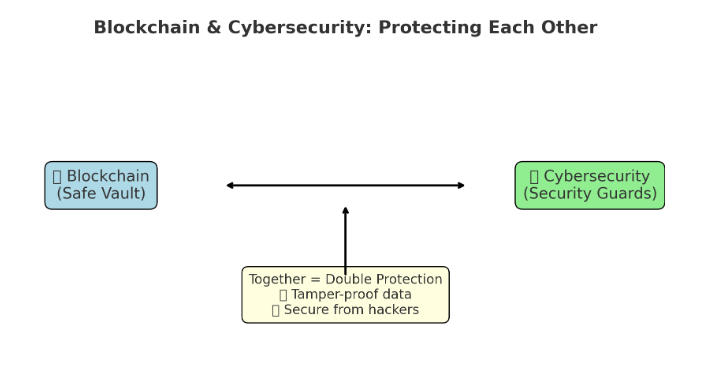
Think of Blockchain as a Safe Vault 🏦 and Cybersecurity as Security Guards 🚨.
- The Vault (Blockchain) ensures once money/data is inside, it cannot be tampered with.
- The Guards (Cybersecurity) ensure no thief/hacker breaks into the vault.
Together, they provide a Double layer of protection.
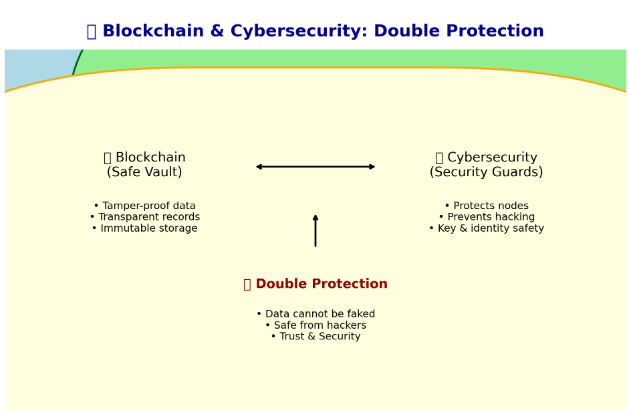
| Blockchain Helps Cybersecurity | Cybersecurity Helps Blockchain |
|---|---|
| Keeps data immutable and tamper-proof | Protects blockchain from external hacking |
| Makes records transparent for trust | Secures private data from leaks |
| Provides strong digital authentication | Manages keys and user identity safely |
| Automates rules with smart contracts | Audits contracts for hidden bugs |
| Eliminates single-point attacks (decentralization) | Safeguards network nodes from malware |
⚙️ Tools That Connect Them
- Hashing (SHA-256): Creates unique digital fingerprints for data.
- Digital Signatures: Verifies sender and receiver identities.
- Public & Private Keys: Encrypt and decrypt data for secure sharing.
- Smart Contracts: Automated rules for safe digital agreements.
- Consensus Mechanisms (PoW, PoS): Ensure all participants agree on valid data.
✅ Conclusion
Blockchain and Cybersecurity are not competitors — they are partners.
- Blockchain secures what’s inside (data, transactions, records).
- Cybersecurity protects the outside (networks, users, infrastructure).
👉 Together, they create a trustworthy, tamper-proof, and hacker-resistant system that can transform industries like finance, healthcare, government services, and education.
The future of digital safety will be built on this powerful combination of Blockchain + Cybersecurity.