
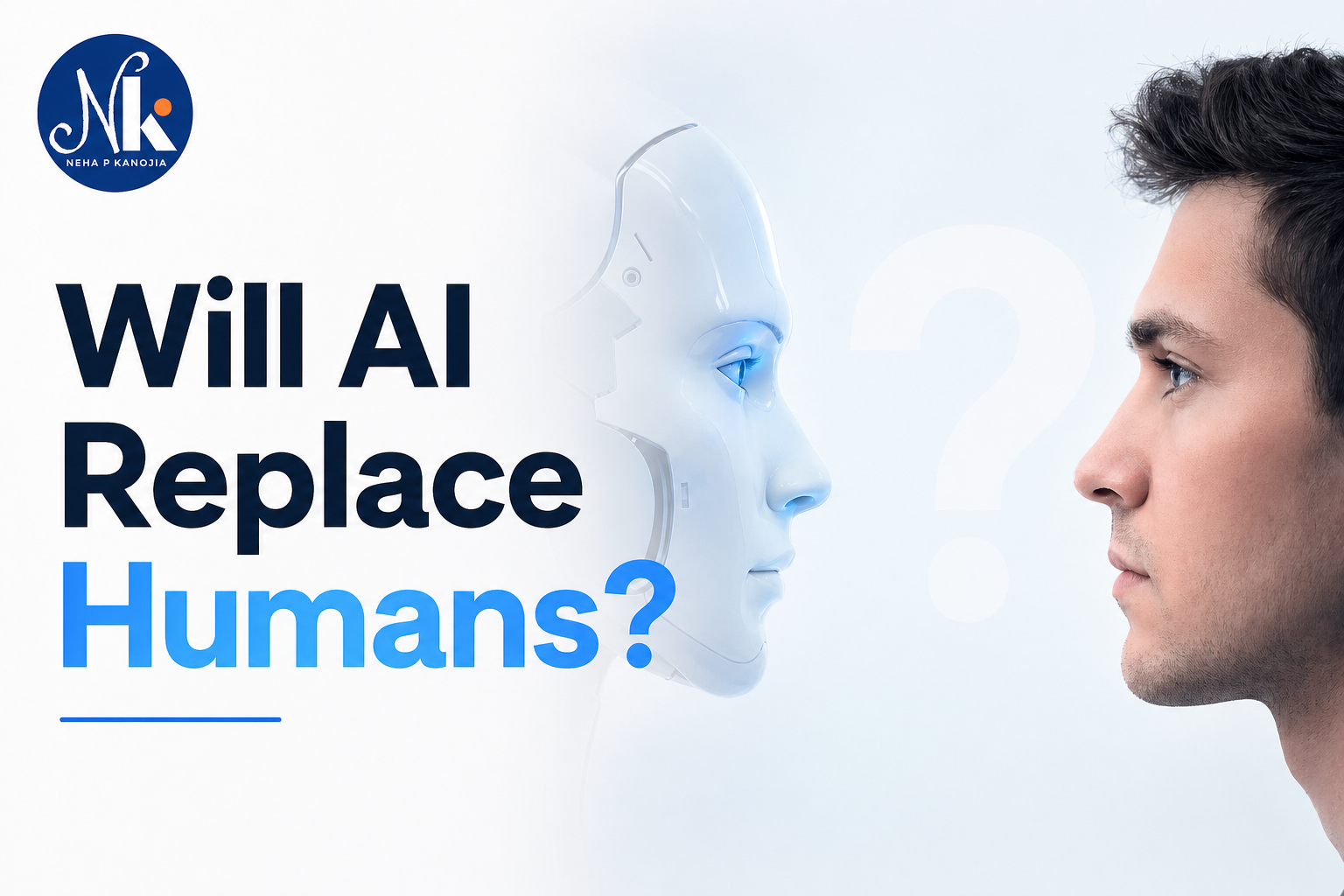
A Reality Check with Facts, Emotions & the Future
We are living in a time where conversations about Artificial Intelligence feel less like science fiction and more like daily life. From chatbots answering questions to algorithms making financial decisions, AI is everywhere. Naturally, one big question arises:
Will AI replace humans?
Let’s not jump to fear or hype. Let’s understand the truth—calmly, clearly, and honestly.
The Reality: AI Is Powerful, But Not Human
Artificial Intelligence is built on concepts like Machine Learning and Deep Learning—systems trained on data to recognize patterns and make decisions.
But here’s the key:
👉 AI does not think, feel, or understand like humans.
👉 It only predicts based on past data.
AI was created for one main reason:
To reduce human errors, increase efficiency, and handle repetitive tasks.
Not to replace humanity.
Can AI Replace Humans? Let’s Break It Down
| Aspect | AI Capability | Human Capability |
|---|---|---|
| Speed & Efficiency | Extremely fast | Slower but thoughtful |
| Creativity | Limited (data-based) | Original & emotional |
| Decision Making | Logical, pattern-based | Ethical, intuitive |
| Emotions | None | Deep empathy & connection |
| Learning | Data-dependent | Experience + wisdom |
👉 Conclusion: AI can replace tasks, not humans.
Where AI Might Replace Jobs (Partially)
Yes, let’s be real—AI will impact jobs.
Jobs at Risk:
- Data entry & repetitive admin work
- Basic customer support (chatbots)
- Routine manufacturing roles
Jobs That Will Grow:
- AI development & management
- Creative industries (design, storytelling, branding)
- Strategic decision-making roles
- Human-centric jobs (teaching, leadership, psychology)
👉 The shift is not “job loss” — it’s job transformation.
If YES: What Happens If AI Replaces Many Roles?
If AI takes over a large number of tasks:
- Humans will move toward creative and strategic roles
- Work hours may reduce, improving lifestyle balance
- New industries will emerge
- Society will need reskilling and adaptation
But here’s the catch:
⚠️ Without preparation, it can lead to:
- Unemployment in certain sectors
- Over-dependency on technology
- Loss of critical thinking
If NO: Why AI Can’t Fully Replace Humans
Even the most advanced AI cannot:
- Feel empathy
- Understand human struggles deeply
- Make moral decisions in complex situations
- Build genuine relationships
AI lacks consciousness and intent.
👉 It doesn’t “care.” Humans do.
And that changes everything.
The Real Risk Is NOT AI — It’s Dependency
This is where the real concern lies.
If humans become fully dependent on AI, then:
- Decision-making skills may weaken
- Creativity may reduce
- Problem-solving ability may decline
👉 AI should assist, not control.
Future Generations: What Must Change?
If we truly care about the next generation, we need to rethink education and mindset.
Essential Skills for the Future:
- Critical Thinking
- Problem Solving
- Creativity
- Emotional Intelligence
- Curiosity & Learning Ability
What Should Be Avoided:
- Blind reliance on AI tools
- Shortcut-based learning
- Ignoring real-world experiences
👉 Teach children how to think, not what to think.
A Simple Story to Understand
Imagine two people:
Person A: Uses AI for everything—writing, thinking, deciding.
Person B: Uses AI as a helper but still thinks independently.
After 10 years:
- Person A becomes dependent, unsure without AI
- Person B becomes powerful, using AI as a tool
👉 Same technology. Different outcomes.
How Life Is Changing with AI
| Before AI | After AI |
|---|---|
| Manual work | Automated systems |
| Time-consuming tasks | Faster execution |
| Limited access to knowledge | Instant global information |
| Skill-based jobs | Skill + tech-based jobs |
👉 Life is becoming easier—but also more complex in responsibility.
Balance Is the Key
AI is not the enemy.
It’s one of humanity’s greatest tools.
But tools are only as good as the hands that use them.
👉 AI cannot take over humans—
unless humans stop using their own minds.
Conclusion
- AI will not replace humans completely
- It will change how we work and live
- The real challenge is how we adapt
- The real power lies in human thinking + AI support