
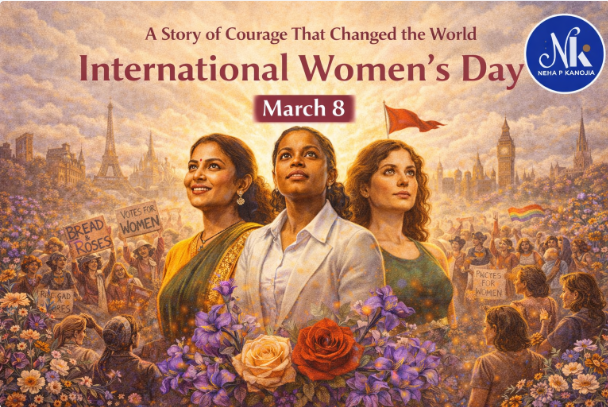
“Women’s Day is not just a celebration of women — it is a reminder of the courage that demanded equality.”
Every year on March 8, the world celebrates International Women’s Day.
Flowers are given, inspiring quotes are shared, and achievements are recognized.
But behind this day lies a powerful history of struggle, courage, and determination.
International Women’s Day was not created as a celebration.
It was born from protest, resistance, and the fight for dignity.
The Beginning: A Cry for Equality
In the early 1900s, women across the world faced serious challenges:
- They worked long hours in factories
- They were paid much less than men
- They had no voting rights
- Their voices were often ignored in society
Women were working hard, but they had no power to decide their future.
This injustice slowly turned into a movement.
The First Spark: 1908 – Women Rise in New York
The story truly begins in 1908 in New York City.
Around 15,000 women workers marched through the streets demanding:
- Better working conditions
- Shorter working hours
- Fair wages
- The right to vote
Their slogan was powerful and simple:
“Bread and Roses.”
Bread symbolized economic security,
Roses symbolized a better quality of life.
This protest shook the world and started a movement.
The First Women’s Day
Inspired by the protests, the Socialist Party of America declared the first National Women’s Day in 1909.
But the idea quickly spread beyond America.
The Woman Who Gave It Global Power
In 1910, a German activist named Clara Zetkin made a historic proposal.
At the International Conference of Working Women in Copenhagen, she suggested:
Every country should celebrate Women’s Day to demand equal rights.
Her idea was supported by 100 women from 17 countries.
That moment gave birth to what we now call:
🌸 International Women’s Day
The First Global Celebration
The first International Women’s Day was celebrated in 1911 across countries like:
- Germany
- Austria
- Denmark
- Switzerland
More than one million women and men joined rallies demanding equality.
This was one of the largest movements for women’s rights in history.
The Day That Changed History – 1917
Another major turning point happened in Russia in 1917.
Women protested against:
- War
- Hunger
- Poor living conditions
Their strike became so powerful that it triggered a revolution.
Just a few days later, women in Russia won the right to vote.
The protest happened on March 8, and this date became permanent.
When the World Officially Recognized It
In 1975, the United Nations officially began celebrating International Women’s Day.
Since then, it has become a global day to:
- Celebrate achievements
- Raise awareness about equality
- Encourage leadership
- Support women’s empowerment
Today, Women’s Day is celebrated in more than 100 countries.
What Women’s Day Really Means Today
International Women’s Day is not only about appreciation.
It represents:
| Then | Now |
|---|---|
| Fight for voting rights | Leadership in politics |
| Demand for fair wages | Equal opportunities |
| Struggle for recognition | Celebration of achievements |
| Breaking social barriers | Empowering future generations |
It reminds us how far women have come — and how much more can be achieved.
A Story That Happens Every Day
Women’s Day is not just about famous leaders.
It is about:
- A mother balancing family and work
- A teacher shaping future generations
- A doctor saving lives
- An entrepreneur building dreams
- A young girl daring to dream bigger
Women’s strength is not only in power —
it is in resilience, compassion, and determination.
A Thought That Touches the Heart
“When a woman rises, she does not rise alone — she lifts generations with her.”
International Women’s Day reminds us that equality is not a gift.
It is something women around the world stood up and fought for.
And because of their courage, the world today is fairer, stronger, and more hopeful.
🌷 Happy International Women’s Day
A day to celebrate strength, courage, and the unstoppable spirit of women.