“The hash puzzle is the lock that protects the blockchain.”
In Proof of Work (PoW), the hash puzzle is the core mechanism that keeps the blockchain secure, decentralized, and tamper-resistant.
Let’s understand it in a clear, structured, and technical way.
What Is a Hash Puzzle?
A hash puzzle is a mathematical problem that miners must solve to add a new block to the blockchain.
👉 In simple words: Miners must guess a special number until the block’s hash meets specific conditions.
Technical Definition
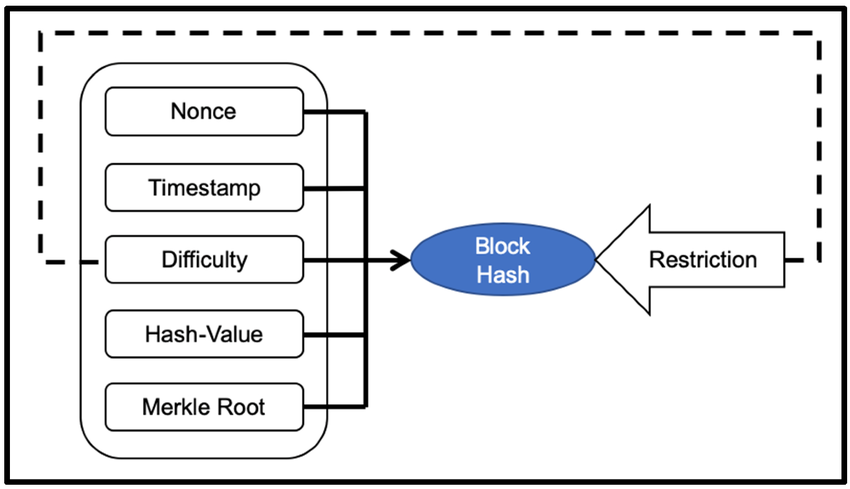
A hash puzzle in Proof of Work is a computational challenge where miners must find a nonce such that the cryptographic hash of the block header is less than a target value defined by the network difficulty.
Mathematically:
Hash(Block Header + Nonce) < Target
Where:
Hash Function → e.g., SHA-256 (Bitcoin) ( will explain in new blog)
Nonce → A variable number miners change
Target → Difficulty threshold set by the network
Block Header → Contains:
Previous block hash
Merkle root
Timestamp
Difficulty
Version
Nonce
How the Hash Puzzle Works
Step
What Happens
1
Transactions are grouped into a block
2
Miner creates block header
3
Miner changes nonce repeatedly
4
Hash function generates output
5
If hash meets difficulty target → Block accepted
6
Miner receives reward
Role of the Hash Puzzle in PoW
The hash puzzle plays several critical roles:
Role
Explanation
Security
Makes it extremely hard to alter blockchain data
Prevents Double Spending
Ensures transaction history cannot be easily modified
Consensus Mechanism
Determines which miner adds the next block
Economic Cost
Requires electricity and hardware investment
Decentralization
Anyone with hardware can participate
Why Is the Puzzle Hard?
The hash function:
Produces unpredictable outputs
Is one-way (cannot reverse-engineer)
Requires brute-force guessing
Example:
Target:
000000xxxxxxxxxxxxxxxxxxxx
Miners must find a hash that starts with many zeros.
The only way is trial and error.
Components of the Hash Puzzle
Component
Function
Hash Function
Converts input into fixed-length output
Nonce
Random number adjusted by miner
Difficulty
Controls how hard the puzzle is
Target
Maximum acceptable hash value
Block Header
Data being hashed
Benefits of the Hash Puzzle
Benefit
How It Helps
High Security
Extremely costly to attack
Tamper Resistance
Changing old block requires re-mining all blocks
Network Stability
Difficulty adjusts automatically
Fair Competition
Based on computational work
Trustless System
No central authority needed
Example: Bitcoin Hash Puzzle
Bitcoin uses:
SHA-256 hashing algorithm
10-minute average block time
Difficulty adjustment every 2016 blocks
Miners try billions of hashes per second to solve the puzzle.
Why Is It Called “Proof of Work”?
Because the miner must prove they have done computational work.
The valid hash acts as evidence.
Other nodes can verify the solution instantly.
Security Strength of Hash Puzzle
To attack the network, an attacker must:
Control 51% of total hash power
Recalculate blocks faster than entire network
This makes attacks:
Extremely expensive
Economically impractical
Difficulty Adjustment
Difficulty changes automatically to maintain consistent block time.
If mining becomes faster → Difficulty increases If mining slows down → Difficulty decreases
This ensures stable block production.
Real-World Analogy
Imagine:
A digital lock with billions of combinations
You must find the correct combination
Only trial and error works
Once found, everyone can easily verify it
That lock is the hash puzzle.
How It Benefits Blockchain Ecosystem
Builds digital trust
Secures financial transactions
Supports decentralized currency
Maintains transparency
Protects historical data
Advantages vs Limitations
Advantages
Proven security (since 2009)
Highly decentralized
Strong resistance to attacks
Limitations
High energy consumption
Hardware competition
Slower scalability
Opinion
The hash puzzle in Proof of Work is:
A computational security mechanism
The backbone of blockchain integrity
A system that converts electricity into digital trust
“Without the hash puzzle, blockchain would be just a database. With it, blockchain becomes secure and decentralized.”