
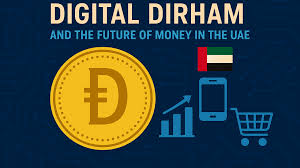
🧭 What is the Digital Dirham?
The Digital Dirham is the United Arab Emirates’ forthcoming central bank digital currency (CBDC) issued by the Central Bank of the UAE (CBUAE).
It is essentially a digital version of the UAE dirham, designed to be issued on a blockchain or distributed ledger platform, to complement cash and bank deposits, with the full backing and trust of the central bank.
Key features:
- Legal tender – it will be interchangeable with cash and deposits.
- Built for retail (public) use, wholesale (banks/institutions) use, and cross-border transactions.
- Designed to improve payment efficiency, inclusion (bringing in unbanked/underbanked), and promote innovation in the digital economy.
- Uses a “two-tier” (or intermediated) distribution model: CBUAE issues, banks/exchange houses/distribution partners handle customer interaction.
🧾 Highlights & Key Points
Here’s a table summarising the core points:
| Topic | Description |
|---|---|
| Purpose | Modernise the payment infrastructure; meet digital economy needs; maintain trust in national currency. |
| Platform / Technology | Built on distributed ledger/blockchain technology (permissioned/private DLT) for speed, transparency, security. |
| Formats | Retail CBDC (rCBDC) for consumers; Wholesale CBDC (wCBDC) for institutions; Cross-border (xCBDC) for international flows. |
| Distribution Model | Two-tier: central bank issues, partner intermediaries distribute and handle wallets, KYC, customer interface. |
| Fees | Designed to reduce transaction cost — potentially zero or very low fees for many use cases (as part of digital payment efficiency). (Note: actual fee-policy may vary) |
| Financial Inclusion | Aimed at reaching unbanked/underbanked individuals, non-residents, cross-border remittances. |
| Privacy & Risk Mitigation | Built-in safeguards: limits on holdings, offline capability, encryption, risk controls for monetary/financial stability. |
| When Available | Phased rollout planned. Retail and wholesale versions expected in the “near term”. Some pilot and cross-border trials already done. |
🔍 Explanation of Some Technical Terms
- CBDC (Central Bank Digital Currency): A digital form of a country’s sovereign currency issued by its central bank, representing a direct claim on the central bank (just like cash).
- DLT (Distributed Ledger Technology): A technology (including blockchain) that records transactions across many nodes (computers) in a network, making data transparent, immutable, and secure.
- Permissioned / Private Blockchain: Unlike public blockchains (e.g., Bitcoin, Ethereum open networks), permissioned blockchains restrict who can validate transactions — typically used by institutions to balance decentralisation with control.
- Intermediated Model / Two-Tier Distribution: In CBDC designs, instead of the central bank handling every end-user wallet directly, it issues the digital currency while banks/fintechs handle retail distribution, onboarding, KYC/AML.
- Retail CBDC (rCBDC): Digital currency meant for general public use (consumers, businesses) for everyday payments.
- Wholesale CBDC (wCBDC): Digital currency used by financial institutions, large-value payments, interbank settlement.
- Cross-border CBDC (xCBDC): Use of CBDC across national borders, enabling remittances, foreign trade without many intermediaries.
📅 When Will It Be Available?
- The UAE’s central bank has already conducted pilots and cross-border tests (for example through Project mBridge) as part of the rollout of the Digital Dirham.
- According to reports, the full public rollout is expected in a phased manner, likely by end of 2025, though exact dates may vary.
- Initially, it will be launched with core use-cases and then expanded to broader usage and features over time.
✅ Real-Time Case Study
Use Case: Retail Consumer Payments in the UAE
Imagine a consumer in Dubai uses their smartphone wallet to buy groceries, pay for public transport, or send money to a family member overseas. With the Digital Dirham:
- They open a wallet provided by their bank or a fintech partner.
- They receive Digital Dirham units (issued by CBUAE via the bank).
- They pay at a store; settlement is instant (or near-instant) because it’s central-bank money on the ledger.
- Fees are minimal or zero, making micro-payments affordable.
- For cross-border: someone working in UAE can send Digital Dirham to a relative overseas, settlement is faster and cheaper than traditional remittance.
This case demonstrates how Digital Dirham could transform everyday payment experience, inclusion (if you are previously unbanked), and international payment flows.
🌟 “Digital Dirham – UAE’s Blockchain Leap into Zero-Fee Digital Money”
🇦🇪💱 Real-Time Case Study: Transferring Funds from UAE to China
Let’s imagine a real-world example — a UAE-based business importing electronics from China. Traditionally, cross-border payments take 2–5 business days, pass through multiple intermediaries (SWIFT, correspondent banks), and include hefty transfer fees and foreign exchange delays.
Now, with the Digital Dirham (CBDC) built on blockchain, everything changes:
| Step | Traditional Process | Digital Dirham Cross-Border Transfer |
|---|---|---|
| 1. Payment Initiation | UAE importer requests payment via bank; manual approval and multiple intermediaries | Importer uses Digital Dirham wallet; payment initiated instantly |
| 2. Network Used | SWIFT + correspondent banks | Project mBridge – a shared blockchain network between the UAE, China, Thailand, and Hong Kong |
| 3. Settlement Time | 2–5 days | Seconds to minutes |
| 4. Fees | High intermediary fees (up to 3–5%) | Almost zero transaction fee (blockchain-based) |
| 5. Transparency | Limited tracking | Full visibility on blockchain ledger |
| 6. Currency Conversion | Delays due to forex clearing | Instant digital FX – Dirham to Digital Yuan through smart contracts |
Now the world of finance fits in your palm — just a tap, and it’s done! That’s the magic of the Digital Dirham era.
🌐 How It Works – The “mBridge” Connection
The Digital Dirham is already being tested in Project mBridge, a joint blockchain initiative between:
- UAE (CBUAE)
- China (People’s Bank of China)
- Hong Kong Monetary Authority (HKMA)
- Bank of Thailand
💡 mBridge uses a shared distributed ledger, enabling participating central banks to directly transact their digital currencies.
So, when a UAE business sends Digital Dirhams to a Chinese exporter, the Dirhams are converted instantly into Digital Yuan (e-CNY) through the shared blockchain — no correspondent bank, no delays, no intermediaries.
This example proves how CBDCs can revolutionize global trade, making it faster, cheaper, and more transparent.
🏢 Example Scenario
AliTech LLC (Dubai) orders electronic components from Shenzhen Electro Co. (China) worth AED 50,000.
Instead of traditional remittance:
- AliTech uses its bank’s Digital Dirham wallet to send the amount.
- The transaction runs through Project mBridge, converting Digital Dirhams to Digital Yuan in seconds.
- Shenzhen Electro Co. receives funds in real-time, confirmed on the blockchain ledger.
- Both parties save money and gain instant confirmation — no waiting, no hidden costs.
Result:
- Settlement Time: Reduced from 3 days → 3 seconds
- Transaction Cost: From 3% → nearly zero
- Security: Guaranteed by the Central Bank of UAE and People’s Bank of China
🌏 Why It Matters
This real-time example showcases:
- How blockchain connects economies directly
- Why CBDCs eliminate remittance pain points
- And how Digital Dirham + Digital Yuan create a new era of trust-based global trade
🧠 My Opinion
The Digital Dirham is a bold and forward-looking step by the UAE. In my view:
- It signals that digital currencies are no longer just experiments — they are becoming mainstream.
- If implemented well (user-friendly wallets, strong security, low fees, good distribution), it could significantly boost the UAE’s status as a financial-innovation hub.
- The “zero fee” (or very low fee) aspect for many use-cases is particularly powerful: it removes friction from payments, which benefits consumers and businesses alike.
- That said, the success will depend on adoption: wallets need to be easy; banks/fintechs must participate; regulation and privacy/safety must be strong.
- For countries like India (you are in India), it offers a blueprint. We may soon see similar initiatives.
In short, the Digital Dirham could mark a new chapter in money: fast, digital, inclusive — and backed by the trust of a central bank.