
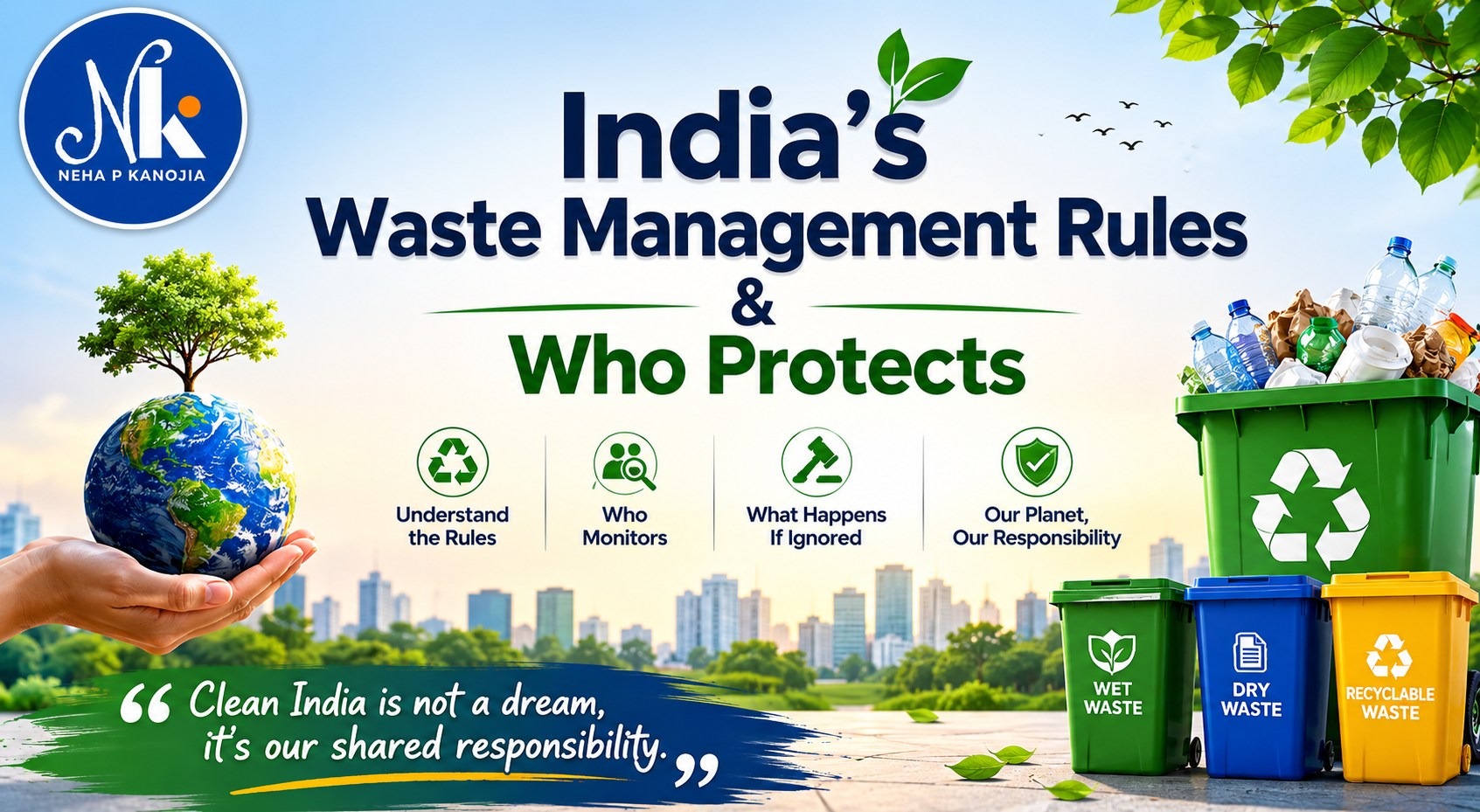
“The Earth does not belong to us alone — it belongs equally to the generations yet to come.”
Every day, India generates thousands of tonnes of waste.
From household garbage to plastic packaging, food waste, construction debris, and non-recyclable plastic — our cities are growing, but so are our dump yards.
The real question is:
❓ Who is responsible for managing this waste?
❓ What rules exist?
❓ Who monitors them?
❓ And what happens if people or companies ignore them?
This blog explains India’s Municipal Solid Waste Management Rules in simple language — not as legal text, but as a responsibility we all share.
Because waste management is not just about garbage.
It is about:
🌬 Clean Air
💧 Safe Water
🌱 Healthy Soil
👨👩👧👦 A healthy future for our children
What Are Municipal Solid Waste Management Rules?
India introduced Solid Waste Management Rules to ensure waste is handled scientifically and responsibly.
The purpose is simple:
✔ Reduce pollution
✔ Prevent illegal dumping
✔ Improve recycling
✔ Protect public health
✔ Reduce landfill pressure
✔ Promote circular economy
These rules apply to:
- Citizens
- Municipal Corporations
- Industries
- Waste processing companies
- Housing societies
- Commercial establishments
- Urban and rural local bodies
Important Sections of the Rules Explained Simply
| Chapter | What It Means |
|---|---|
| Short Title & Commencement | Official start of the rules |
| Application | Where and to whom the rules apply |
| Definitions | Meaning of important terms |
| Solid Waste Management | How waste should be handled |
| Environmentally Sound Management | Protecting air, water & soil |
| Sanitary Landfills | Scientific disposal systems |
| Roles & Responsibilities | Duties of citizens & authorities |
| Implementation Framework | How rules are executed |
| Fire Prevention | Preventing dump yard fires |
| Reporting Forms | Monitoring & compliance system |
What Does Proper Waste Management Mean?
The rules clearly say waste must be managed scientifically.
Correct Waste Flow
| Step | Action |
|---|---|
| 1 | Waste segregation at source |
| 2 | Collection by municipal body |
| 3 | Transportation in covered vehicles |
| 4 | Processing, recycling, composting |
| 5 | Scientific disposal of remaining waste |
Why These Rules Matter
Improper waste handling affects everything around us.
| If Waste Is Ignored | Impact |
|---|---|
| Open dumping | Soil pollution |
| Burning plastic | Toxic air |
| Poor landfills | Groundwater contamination |
| Mixed waste | Reduced recycling |
| Legacy plastic | Long-term environmental damage |
What Is a Sanitary Landfill?
A sanitary landfill is not just an open dump yard.
It is a scientifically managed site with:
✔ Protective lining
✔ Gas control systems
✔ Drainage systems
✔ Monitoring mechanisms
Purpose:
Prevent pollution from entering the environment.
Why Dump Yard Fires Happen
Many waste dump sites catch fire because:
- methane gas builds up
- plastic waste accumulates
- waste is unmanaged
The rules now include:
✔ Fire prevention measures
✔ Emergency management systems
✔ Scientific remediation methods
Who Monitors Waste Management in India?
Many people think only municipalities are responsible.
But waste management is monitored at multiple levels.
Monitoring Authorities
| Authority | Responsibility |
|---|---|
| Central Pollution Control Board (CPCB) | National monitoring & policy enforcement |
| State Pollution Control Boards (SPCBs) | State inspections & legal action |
| Municipal Corporations | Waste collection & ground implementation |
| Urban Local Bodies | Local waste management systems |
| Ministry of Environment | National environmental governance |
What Do These Authorities Monitor?
They check whether:
✔ Waste is segregated properly
✔ Plastic is processed scientifically
✔ Dump yards are managed safely
✔ Waste is illegally dumped or burned
✔ Companies follow EPR rules
✔ Pollution standards are maintained
What Happens If Someone Does NOT Follow the Rules?
The government has strong powers to take action.
Actions & Penalties
| Violation | Possible Action |
|---|---|
| Illegal dumping | Heavy fines |
| Burning waste openly | Environmental compensation |
| Running facility without approval | Closure notice |
| Ignoring plastic waste rules | EPR penalties |
| Repeated violations | Suspension or legal action |
| Pollution of water or land | Criminal/environmental proceedings |
What Is Environmental Compensation?
This means:
Polluters must PAY for the environmental damage they cause.
The amount depends on:
- quantity of waste
- pollution caused
- duration of violation
- environmental impact
What About Companies Producing Plastic?
Under India’s EPR (Extended Producer Responsibility) framework:
Companies generating plastic packaging are responsible for ensuring its collection and processing.
This includes:
- Producers
- Importers
- Brand owners
- FMCG companies
If they fail:
✔ Notices can be issued
✔ Registrations can be suspended
✔ Heavy compensation can apply
✔ Legal action may follow
Prevention Is Better Than Punishment
The goal of the rules is not fear.
The real goal is:
Prevention
India wants:
✔ Cleaner cities
✔ Less landfill waste
✔ Better recycling systems
✔ Sustainable solutions
✔ Responsible citizens
Why Citizens Matter Most
Government alone cannot clean India.
If citizens:
- litter roads,
- mix wet and dry waste,
- burn garbage,
- ignore segregation,
then even the best policies will struggle.
Every wrapper thrown carelessly becomes:
- pollution in soil
- toxins in air
- contamination in water
The Need for Innovation & Responsibility
India now needs:
✔ better implementation
✔ public participation
✔ technology-driven solutions
✔ responsible industries
✔ Waste-to-Wealth innovations
Solutions already exist that can:
- reduce landfill burden
- process non-recyclable plastic
- create circular economy models
- support cleaner cities
But real success will happen only when:
Government, industries, municipalities, and citizens work together.
❤️ A Message to Every Indian
Before throwing waste carelessly, ask yourself:
“What kind of India am I leaving behind?”
Because:
- the air we pollute today will be breathed by our children tomorrow
- the water we contaminate today will return to us tomorrow
- the soil we damage today will grow tomorrow’s food
A clean India is not somebody else’s responsibility.
It is:
🇮🇳 Our duty
🇮🇳 Our culture
🇮🇳 Our future
“Rules can punish pollution, but only responsibility can protect the future.” ♻️