
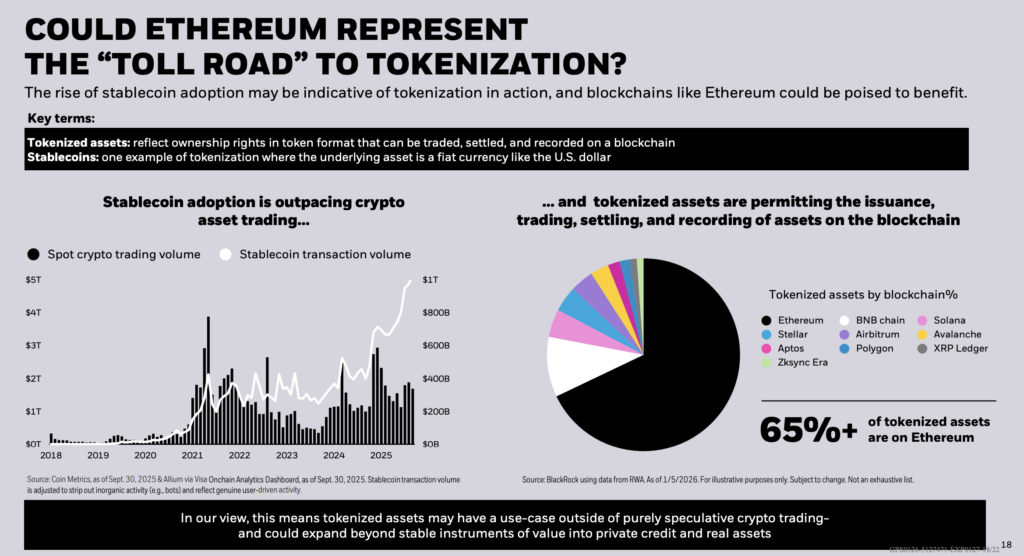
The world’s largest asset manager, BlackRock, has made its position clear:
Ethereum is at the center of its tokenization strategy.
But there’s a quiet detail beneath the headline — Ethereum’s market share, while still dominant, is not fixed. And that matters more than it sounds.
Let’s break this down in simple, easy-to-understand language.
🧠 First, What Is Tokenization?
Tokenization means converting real-world assets into digital tokens on a blockchain.
Examples:
- Bonds
- Funds
- Real estate
- Treasury bills
- Cash equivalents
Instead of paper records, ownership is represented digitally and can move faster, cheaper, and more transparently.
🛣️ What Does BlackRock Mean by Ethereum as a “Toll Road”?
BlackRock’s 2026 Thematic Outlook asked an important question:
👉 Can Ethereum act like a toll road for tokenized assets?
A toll road earns money not by owning the cars, but by charging fees when traffic passes through.
In Ethereum’s case:
- Assets are issued on Ethereum
- Transactions settle on Ethereum
- Fees are paid on Ethereum
So even if many assets exist, Ethereum benefits from the activity, not from price speculation alone.
📊 BlackRock’s Key Claim
BlackRock stated:
“65%+ of tokenized assets are on Ethereum.”
However, there’s an important clarification.
BlackRock adjusted stablecoin transaction data to remove “inorganic activity” such as:
- Bots
- Wash transfers
- Artificial volume
This means BlackRock focused on real economic usage, not raw transaction counts.
⚠️ Why This Adjustment Matters
Many investors look at:
- Transaction volume
- Activity metrics
But if those numbers include bots, they can overstate real usage.
BlackRock’s approach narrows the data to:
✔ Meaningful transactions
✔ Real asset movement
✔ Economic throughput
This makes Ethereum look strong — but also exposes where competition can creep in.
🔄 Ethereum’s Market Share Is a Moving Target
Independent on-chain data shows Ethereum is still leading — but with some drift.
📋 Tokenized RWA Market Share Comparison
| Data Source | Ethereum Share / Value | Date |
|---|---|---|
| BlackRock Tokenization Slide | 65%+ share | Jan 5, 2026 |
| RWA.xyz Directory View | 59.84% share (~$12.8B) | Jan 22, 2026 |
| RWA.xyz Networks Table (excl. stablecoins) | $13.43B total value | Jan 21–22, 2026 |
👉 Ethereum is still the leader — but not as dominant as one static snapshot suggests.
🌍 Why Is Ethereum’s Share Drifting?
This doesn’t mean Ethereum is “losing.”
It means the ecosystem is expanding.
Share drift happens because:
- New blockchains support tokenized RWAs
- Issuers diversify across networks
- Settlement may occur on different chains
- Reporting windows differ
As tokenization grows, more roads are being built, even if Ethereum remains the main highway.
🔍 What BlackRock Is Really Saying.
BlackRock is not making a price call on ETH.
Instead, it is:
- Positioning Ethereum as infrastructure
- Treating it like financial plumbing
- Focusing on where issuance, settlement, and fees occur
This is a utility-first view, not a speculative one.
Ethereum’s value, in this thesis, comes from:
✔ Being used
✔ Being trusted
✔ Being integrated into institutions
🧩 The Real Question Going Forward
The success of Ethereum as a “toll road” depends on:
- Where assets are issued
- Where they settle
- Where fees are ultimately paid
If more issuance moves to other chains — even partially — Ethereum’s share can gradually dilute, while still remaining central.
So the debate is no longer:
“Is Ethereum important?”
It is:
“How exclusive will Ethereum remain?”
🌈 In simple way
- BlackRock sees Ethereum as the backbone of tokenization
- Ethereum still hosts the majority of tokenized assets
- But its dominance is not guaranteed or static
- Tokenization is expanding beyond one chain
- Ethereum’s future role is infrastructure, not monopoly
✨ My Opinion
Ethereum doesn’t need to own everything to matter.
Just like highways, ports, or payment rails —
the network that enables movement often matters more than the assets themselves.
BlackRock’s bet is not that Ethereum wins alone —
but that Ethereum stays essential.
And in a multi-chain future, being essential may be the strongest position of all.