

The BelNet network (Beldex’s decentralized VPN or dVPN) already gives users privacy and anonymity. But to make it fast, reliable, and resistant to abuse, Beldex adds an AI agent — a smart component that helps manage traffic, distribute load, detect misuse, and keep the network running smoothly.
In this blog, we’ll explain:
- What BelNet and dVPN are
- What roles Beldex AI plays in BelNet
- How routing, load balancing, and anti-abuse work
- Technical terms explained
- Challenges & considerations
- My opinion
Let’s go step by step.
What Is BelNet / dVPN?
- VPN (Virtual Private Network): A service that encrypts your internet traffic and routes it through another server, hiding your real IP address and location.
- dVPN (Decentralized VPN): Instead of relying on a single centralized VPN provider, traffic is routed through many nodes run by community participants. This removes a central point of trust or failure.
BelNet is Beldex’s dVPN: it uses the Beldex network (masternodes, exit nodes) to route users’ traffic in a decentralized way. It aims to hide metadata (who visits what site), encrypt traffic, and resist censorship.
However, decentralized networks face challenges: traffic congestion, node overload, malicious or underperforming nodes, and dynamic network conditions. This is where Beldex AI steps in.
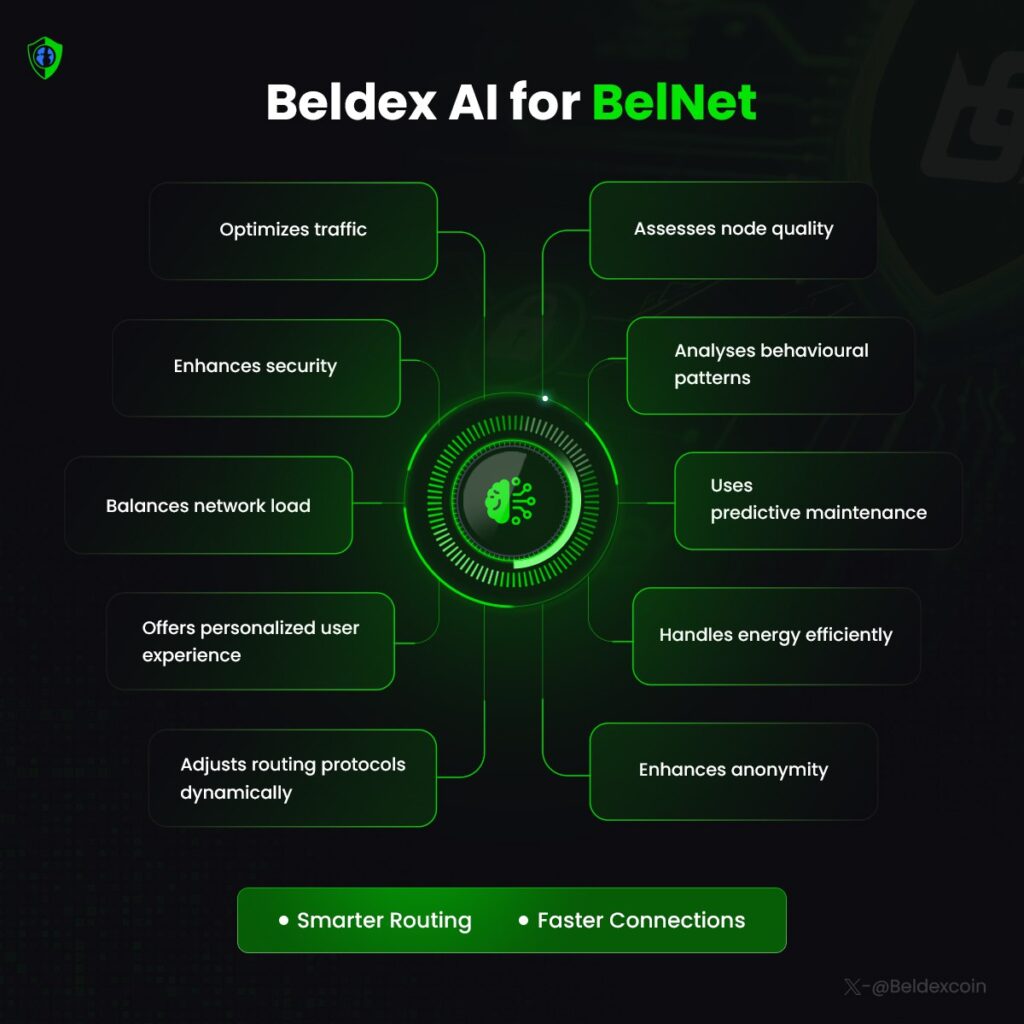
What Does Beldex AI Do in BelNet?
Beldex AI is an “agent” (a software component) that works behind the scenes to optimize how traffic flows across BelNet. Its main responsibilities are:
- Routing Optimization – choosing which path your data should take
- Load Balancing – ensuring no node is overwhelmed
- Network Abuse Prevention – detecting malicious behavior or misuse
- Ensuring Seamless Experience – minimizing slowdowns, dropouts
Let’s break each down.
1. Routing Optimization
- The AI watches network conditions (which nodes are fast, which are congested).
- It picks exit nodes or intermediate nodes that yield the best performance (low latency, good bandwidth).
- It can dynamically re-route traffic if a node becomes slow or fails.
This means your browsing, streaming, or other traffic avoids bottlenecks and uses smoother paths.
2. Load Balancing
- If many users send traffic through one node, it can become overloaded.
- AI monitors node usage metrics (bandwidth, CPU, latency) and shifts traffic to nodes that are underutilized.
- This spreads work more evenly, improving stability and reducing bottlenecks.
3. Preventing Network Abuse
- The AI can detect nodes or users behaving maliciously (for example, flooding with traffic, acting as a bad exit node, launching attacks).
- It can flag or isolate misbehaving nodes.
- It helps maintain the health and reputation of the network by limiting abuse or misuse.
4. Keeping BelNet Running Seamlessly
Because AI is continuously monitoring and adjusting, users experience fewer disruptions. The AI helps with:
- Faster route recalculations
- Adapting to network changes (nodes going offline/online)
- Keeping overall network performance high
Summary Table: Beldex AI in BelNet
| Function | What It Does | User Impact / Benefit |
|---|---|---|
| Routing Optimization | Chooses fast, less congested paths | Lower latency, faster data flow |
| Load Balancing | Distributes load across nodes | More stable connections, less overload |
| Abuse Detection | Spots malicious or bad nodes | Better security and trust |
| Seamless Maintenance | Auto-adapts to changing network | Fewer disruptions for users |
Technical Terms & Their Meanings
| Term | Simple Explanation |
|---|---|
| Agent | A program component that makes decisions autonomously. |
| Latency | Delay in data travel time (how long it takes). |
| Bandwidth | The data capacity or speed of a node / connection. |
| Node | A point in the network (a server or relay). |
| Exit Node | The last node in a VPN path that sends traffic to the regular Internet. |
| Congestion | When too many users try to use the same route or node, slowing traffic. |
Challenges & Things to Watch Out For
While the AI approach is powerful, it also has caveats:
- Complexity: Building an AI routing & balancing system is hard. Mistakes may cause wrong routing, bottlenecks, or even compromise privacy.
- Data Privacy: The AI must not learn or expose user data. The decisions it makes must preserve confidentiality.
- Fairness & Incentives: Node operators should be rewarded fairly; otherwise good nodes may drop out.
- Reacting to Fast Changes: The network can change quickly (nodes go offline). AI must adapt fast.
- False Positives in Abuse Detection: Legitimate nodes/users might be flagged incorrectly.
My Opinion
I believe adding AI to BelNet is a smart and needed move. Privacy networks often struggle with performance — people don’t use them if they’re too slow or unstable. Beldex AI helps bridge that gap by making the network adaptive.
However, the true success will depend on how well the AI is designed and how transparent it is. If it remains a black box, users may worry about what it’s doing. Also, community participation and node performance need strong incentives and oversight to keep the system honest.
So, I’m optimistic — but cautious. If Beldex can get the AI working reliably while maintaining privacy, this could be a standout in the dVPN / privacy space.