
ndia is often described with powerful headlines.
The fastest growing major economy.
The fourth largest economy in the world.
These statements are true, and they represent an important moment in India’s economic journey. Infrastructure is expanding, businesses are growing, and global companies are investing in the country.
But behind these impressive numbers lies a deeper question.
Is economic growth reaching everyone?
When we look closely at how income and wealth are distributed, a very different story begins to appear.
This is a story about opportunity, inequality, and the future direction of India’s development.
The Top 10%: Where Most Wealth Is Concentrated
The top 10 percent of Indians earn nearly 60 percent of the country’s total income and control around 65 percent of total wealth.
What does this actually mean?
Imagine a room with ten people representing the Indian population. One person in that room would control almost two-thirds of the money and assets present in that space.
This group typically includes successful entrepreneurs, corporate leaders, large business owners, and high-income professionals. Many of them are driving innovation, creating jobs, and building companies that contribute significantly to the economy.
There is nothing inherently wrong with wealth creation. In fact, wealth creation is essential for economic growth.
But when such a large share of wealth is concentrated among a small portion of the population, the benefits of growth may not spread evenly.
The Middle 40%: Carrying the Weight of Aspiration
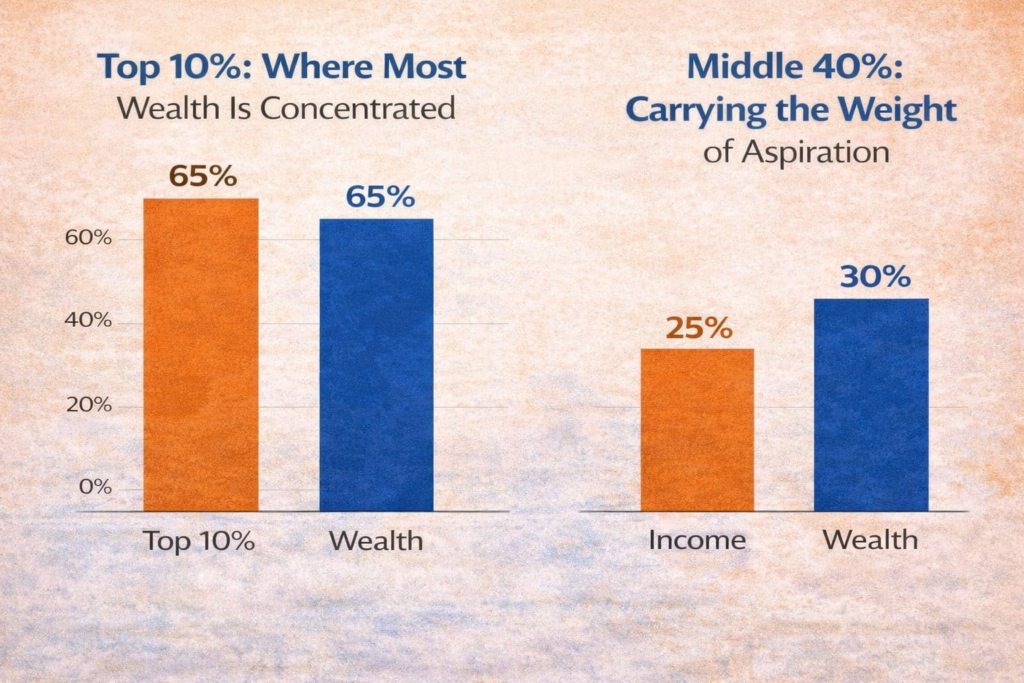
India’s middle 40 percent earn about 25 percent of the total income and hold around 30 percent of the country’s wealth.
This group includes millions of salaried employees, small business owners, professionals, and entrepreneurs who form the backbone of the economy.
They pay taxes, drive consumption, support industries, and invest in education for the next generation. Their aspirations shape the country’s economic momentum.
Yet many in this group feel financially stretched. Rising housing costs, education expenses, healthcare costs, and lifestyle inflation often make it difficult to accumulate wealth.
They are earning, working, and contributing, but building long-term financial security remains challenging.
The Bottom 50%: The Struggle for Stability

The most concerning statistic lies here.
The bottom half of the population earns only around 15 percent of the country’s income and controls just about 6 percent of total wealth.
This group includes workers in informal sectors, daily wage earners, small farmers, and millions of families living with limited financial security.
For many of them, economic growth is not experienced through stock markets or investment portfolios. It is experienced through daily survival — finding stable work, managing household expenses, and securing basic opportunities like education and healthcare.
When half of the population holds such a small share of wealth, it raises important questions about access, opportunity, and inclusion.
The GDP Illusion
India’s economy is large. Being among the world’s largest economies is a remarkable achievement.
However, the size of an economy does not automatically reflect how prosperous its citizens are.
One way economists measure this is through GDP per capita, which divides the country’s total economic output by its population.
In this measure, India still does not rank among the top 50 countries globally.
This indicates that while the overall economic pie is growing, the share each individual receives remains relatively small compared to many other countries.
Growth Versus Distribution
Economic growth and wealth distribution are two different things.
Growth increases the size of the economic pie.
Distribution determines how that pie is shared.
A country can grow rapidly while still leaving large segments of its population behind. At the same time, inclusive growth ensures that prosperity spreads across different sections of society.
When more people participate in economic growth, the entire system becomes stronger.
Education improves. Consumption rises. Innovation spreads. Businesses expand.
In many ways, reducing inequality is not just a social goal. It is also an economic strategy.
Can India Become a Developed Nation?
This leads to the central question.
Can India truly become a developed nation if such a large divide exists between different economic groups?
Development is not defined only by skyscrapers, technology hubs, or rising stock markets.
True development is reflected in the quality of life of ordinary citizens — access to education, healthcare, stable income, and opportunities to grow.
For India to move toward developed nation status, growth must become more inclusive.
This means expanding quality education, improving job creation, strengthening social infrastructure, supporting small businesses, and encouraging financial inclusion.
When the middle class grows stronger and the bottom half gains greater economic opportunity, the foundation of development becomes much stronger.
A Nation’s Progress Is Measured by Its People
India’s economic story is still being written.
The country has extraordinary potential, a young population, and an increasingly dynamic economy.
But the real measure of progress will not only be how large the economy becomes. It will be how widely prosperity is shared.
The question is not whether India can grow.
The question is whether that growth can reach every layer of society.
Because in the end, a nation does not become developed when a few become very wealthy.
A nation becomes developed when opportunity becomes possible for everyone.