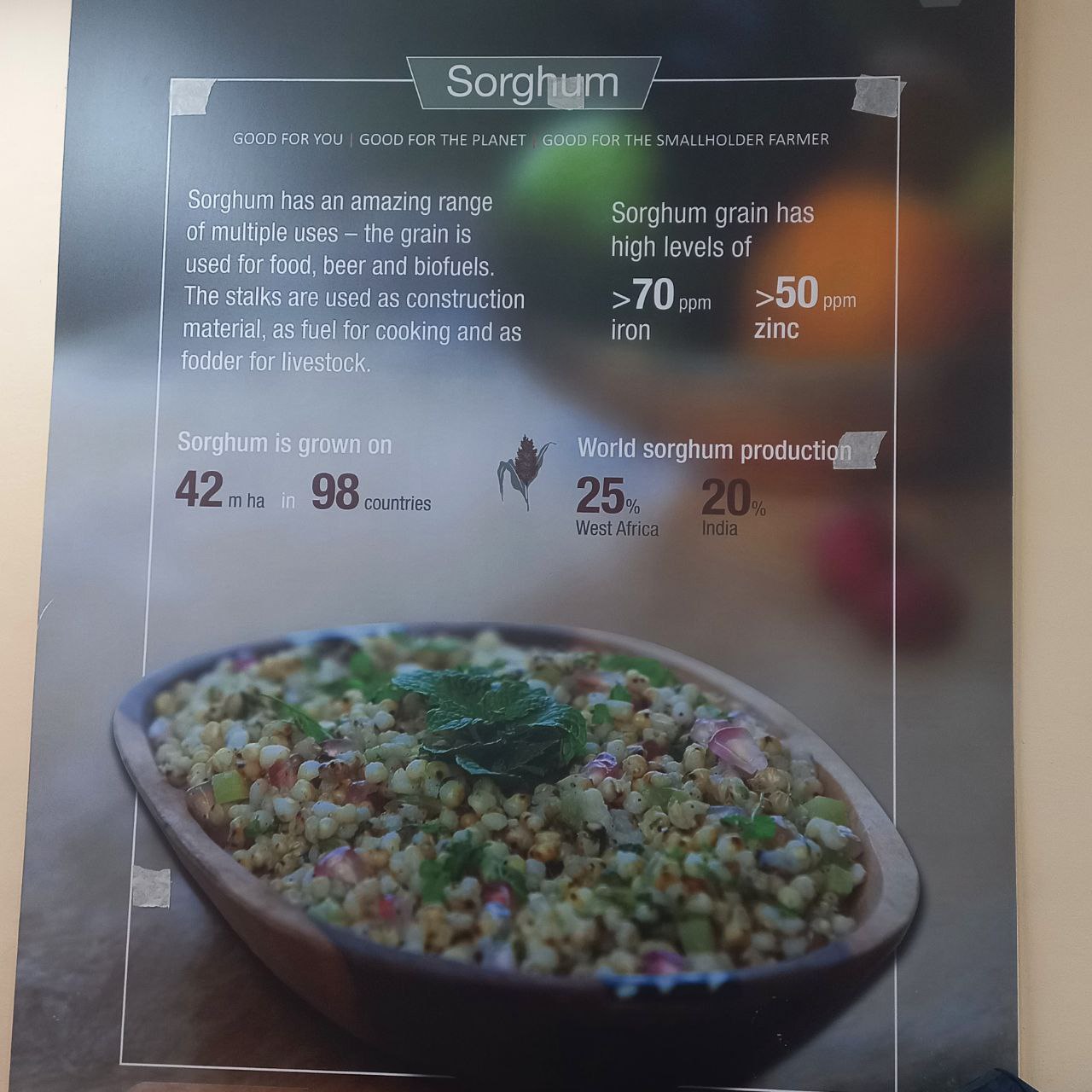
When I visited ICRISAT (The International Crops Research Institute for the Semi-Arid Tropics), I stood in front of a display that celebrated Sorghum — known to us as Jowar. The poster wasn’t just information… it was history, science, culture, and pride woven together.
Looking at the vibrant bowl of sorghum grains, I felt something shift inside me. This wasn’t just food — this was a grain with a journey… a grain with a purpose.
🌍 The Story of Sorghum — A Grain Older Than Civilizations
Sorghum is one of the world’s oldest cultivated crops. It originated in Africa, where communities relied on it for energy, strength, and survival. From there, the grain traveled across continents — carried through trade routes, cultural exchanges, and human migrations.
The display at ICRISAT told a powerful truth:
Sorghum is grown on 42 million hectares
Across 98 countries
25% of global production comes from West Africa
And 20% from India
This means India didn’t just adopt sorghum… India embraced it, nurtured it, and made it part of our identity.
🇮🇳 How Sorghum Came to India — And Why It Stayed
Thousands of years ago, sorghum arrived in India through ancient trade routes connecting Africa and India. Our ancestors immediately recognized its strength:
It grows in harsh, dry climates
It survives with less water
It nourishes people with high iron and zinc
And it feeds livestock, supports farmers, and sustains communities
In India’s semi-arid regions — Maharashtra, Karnataka, Telangana, Rajasthan — Jowar became a lifeline. Farmers depended on it not just as a crop, but as a tradition. It filled plates, gave energy, and kept families strong long before modern nutrition science existed.
That’s why standing in ICRISAT that day, I felt proud. This wasn’t a forgotten grain… This was a grain rooted in who we are.
🧬 What Makes Sorghum a Superfood?
The poster highlighted two powerful nutrients:
Iron: more than 70 ppm
Zinc: more than 50 ppm
These are essential for:
Hemoglobin formation
Immunity
Brain development
Mental clarity
Strength and stamina
No wonder our grandparents lived strong, active lives — their plates were filled with nature’s medicine.
🌱 ICRISAT’s Effort — A Gift to India and the World
ICRISAT has spent years researching sorghum, improving its seeds, and teaching farmers how to grow it sustainably.
They focus on:
Climate-resilient agriculture
Supporting smallholder farmers
Improving global food security
Bringing ancient grains back to modern diets
When I stood there reading the poster, I realized something important:
ICRISAT is not just conserving crops. It is conserving culture, health, and the future of food.
Today, as lifestyle diseases increase and soil quality decreases, sorghum is making a comeback — and ICRISAT’s work is the reason we understand its value again.
🍽️ Sorghum on Our Plates — Tradition Meets Today
The image of the bowl filled with colorful sorghum grains reminded me of thousands of Indian households where Jowar is celebrated through:
Bhakri
Rotis
Khichdi
Upma
Laddu
Porridge
Sprouted salads
Modern nutritionists now call it a super grain, but our ancestors already knew its worth.
💛 Standing in ICRISAT
As I stood in the ICRISAT campus, reading about Sorghum, I felt deeply grateful. Grateful for our farmers. Grateful for our heritage. Grateful for a grain that survived time, climate, and geography to reach our plates.
The world may call it sorghum, but to us, it will always be Jowar — our strength, our soil, our story.
“Some grains feed the body. But ancient grains like sorghum feed the body, the land, and the legacy of generations.”