
“What we send into space always finds its way back — in consequences.”
🛰️ The Image That Speaks a Thousand Truths
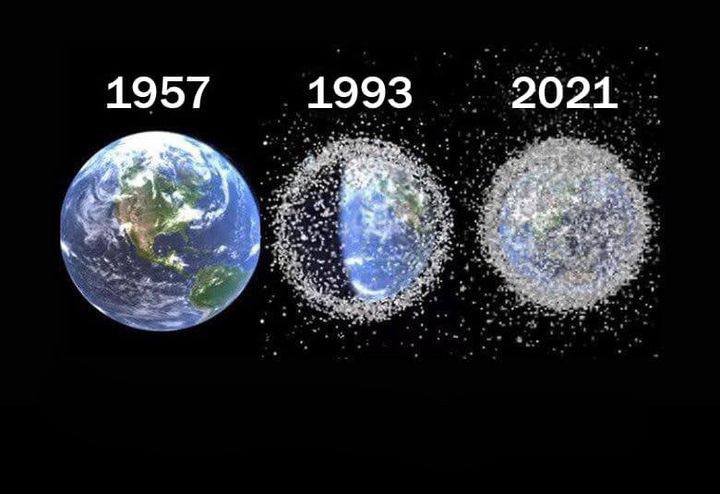
This image — showing Earth in 1957, 1993, and 2021 — powerfully captures humanity’s growing presence in space.
At first glance, it looks almost beautiful — our planet surrounded by tiny dots of light. But behind this visual lies a story of innovation, progress, and a rising environmental concern beyond our atmosphere — space debris.
🚀 From a Single Satellite to Thousands in Orbi
- 1957: The journey began with Sputnik 1, launched by the Soviet Union — the first man-made object to orbit Earth.
- 1993: Space exploration and communication technology expanded rapidly. More countries joined the space race, leading to a noticeable “halo” of satellites around Earth.
- 2021: The space around our planet became densely populated — not just with functioning satellites but also with debris from old spacecraft, rocket fragments, and collision remains.
As of now, there are over 2,600 active satellites, but if we count inactive ones and debris, the number crosses tens of thousands of objects orbiting Earth.
⚠️ The Unseen Pollution Above Us: Space Debris
These floating pieces aren’t harmless. They travel at speeds up to 28,000 km/h — enough to destroy another satellite upon impact.
Even a fragment as small as a screw can cause catastrophic damage in orbit.
The main contributors:
- Broken satellite parts
- Used rocket stages
- Accidental collisions and explosions
- Abandoned spacecraft
This has created what scientists call the Kessler Syndrome — a chain reaction where one collision generates debris that triggers even more collisions.
🌐 Why This Matters to Us on Earth
You might think — “It’s up there, why should I care?”
But here’s why it matters:
| Impact Area | How It Affects Us |
|---|---|
| Communication | Damaged satellites can disrupt GPS, Internet, and phone networks. |
| Weather Forecasting | Satellites critical for predicting storms and climate could be lost. |
| Space Missions | Launching new missions becomes riskier and more expensive. |
| Global Economy | Satellite failures can impact airlines, banking, and logistics. |
🌱 Cleaning the Cosmic Trash
The good news — global agencies and startups are working on space sustainability.
Some promising solutions include:
- “Space sweepers” – robotic arms or nets to capture debris.
- Laser systems to de-orbit small fragments safely.
- Designing self-disposing satellites that burn up on re-entry after mission completion.
- Global space traffic management to avoid collisions.
💫 A Thought to Leave You With
The image isn’t just a timeline — it’s a warning.
Humanity’s ambition has reached beyond Earth, but so have its mistakes.
If we’ve learned to pollute our skies, we must also learn to clean and protect them.
“Space is humanity’s shared frontier — what we do up there will decide what kind of world we live in down here.”
“Innovation is powerful — but responsibility is what defines us.”