
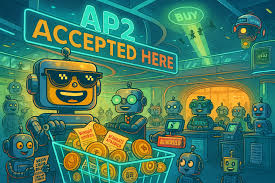
In 2025, many tech giants are racing to build the next generation of the internet — one where AI agents (smart software helpers) act on your behalf. Google’s latest move, Agent Payments Protocol (AP2), is a foundational piece in that future. It ensures those AI agents can pay, transact, and operate under secure, verifiable rules.
Let’s break it down.
🔍 What Is AP2?
- AP2 = Agent Payments Protocol: A new open standard developed by Google, in partnership with over 60 companies (e.g. Mastercard, PayPal, Coinbase) to allow AI agents (or automated assistants) to conduct transactions (buying, paying) on behalf of people.
- It works alongside other protocols like A2A (Agent-to-Agent) and MCP (Model Context Protocol) to create a complete stack for AI-driven commerce.
- Payment-agnostic: AP2 is designed to support many kinds of payments — credit/debit cards, bank transfers, stablecoins, and other crypto—so it doesn’t force everything to be crypto-only.
🧩 How AP2 Works: Mandates & Trust
At the heart of AP2 lie “Mandates” — digital contracts that record what a user has authorized an agent to do. These ensure transparency, accountability, and security.
These mandates are cryptographically signed (think of it like a digital seal) and tamper-proof. They help guarantee that an agent isn’t doing something unexpected or unauthorized.
💡 Key Features & Advantages of AP2
- Security & Accountability You can always trace back what instruction you gave (Intent) and what the agent did (Cart). That way, if something goes wrong, there’s evidence.
- Interoperability Across Payment Types With support for cards, bank transfers, stablecoins, and crypto, AP2 allows agents to operate in both traditional and blockchain worlds.
- Support from Big Players Over 60 companies — such as Mastercard, PayPal, American Express, Coinbase — have pledged to support AP2. This helps it gain trust and adoption faster.
- Enables Agentic Commerce Instead of you doing every click or search, your AI helper can shop, compare prices, negotiate, and pay — all while you sleep.
- Crypto/Stablecoin Integration (x402 Extension) AP2 has an extension called x402 that allows agents to pay each other using stablecoins or crypto. That’s how microtransactions and automation in Web3 get unlocked.
⚠️ Challenges & Concerns
Even with its potential, AP2 faces several hurdles:
- Complex Integration Traditional payment systems (banks, merchant systems) are old and complex. Adding AP2 mandates into them will take work.
- Regulation & Compliance Who’s responsible if an agent makes a mistake? You? The merchant? The agent? Regulations (fraud, anti-money laundering) must adapt.
- Security & Agent Misuse A malicious agent could overstep its mandate. The protocol must guard against fraud, collusion, or “dark patterns.”
- Adoption & Standardization For AP2 to succeed, many merchants, banks, and platforms must adopt it. Fragmented systems won’t help.
📌 Why This Matters (Big Picture)
- AP2 is like building the plumbing for this new age of commerce. Without a trusted standards protocol, agent purchases would be chaotic, risky, and fragmented.
- With AP2 + x402, crypto becomes a native part of agent commerce — stablecoins and digital assets can be used side by side with credit cards.
- This also marks a convergence of AI + Payments + Blockchain — which can disrupt fintech, e-commerce, and Web3.
💬 My Opinion
Google’s AP2 is a bold, necessary step toward the future of how we shop, live, and automate. It’s not perfect yet, but it sets the groundwork for AI agents you can trust.
I believe:
- AP2 will push mainstream adoption of crypto and stablecoins because now agents can use them naturally.
- The mandates concept (Intent → Cart) is brilliant — it gives users control while letting agents operate.
- The biggest battle will be around regulation, standards, and ecosystems. Whoever shapes those will influence whether this future is open/decentralized or controlled.
- As a user, this could mean I no longer have to do mundane tasks like price comparisons, booking, or payment — my agent might handle them for me. But I also want transparent rules and fail-safes, so things don’t go wrong.