
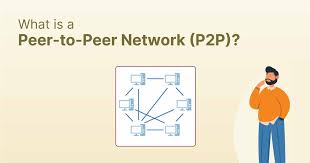
🌐 What is a P2P Network?
P2P (Peer-to-Peer) Network is a type of computer network where all computers (peers) are equal.
👉 Each peer can send and receive data directly from another peer without needing a central server.
In short:
- No boss, no middleman.
- Everyone shares and helps each other.
🧩 Simple Example
- Client-Server (Normal Way): Imagine a school library 📚. Students (clients) can only borrow books from the librarian (server). If the librarian is absent, no books can be issued.
- P2P Network: Imagine a group of friends 📖. Each friend brings their own books and they exchange books directly with each other. Even if one friend leaves, others can still share.
💡 Real-Life Examples of P2P
- File Sharing: Torrents (BitTorrent) – people share movies, music, or files directly.
- Crypto (like Beldex or Bitcoin): People send money directly without going through a bank.
- Messaging Apps (like BChat): Messages go from one user to another without being stored on a central server.
✨ So, a P2P network = direct connection between equals.
Would you like me to also make a comparison table of Client-Server vs P2P so it’s even clearer?
Why is it Called P2P?
It’s called Peer-to-Peer because every participant is both a client and a server.
- In client-server, one controls, others depend.
- In P2P, all are equal, no single point of control.
🔹 Why P2P Networks are Used?
P2P networks are used because they allow direct sharing of data, files, or money without depending on a middleman (like banks, servers, or companies).
👉 They make systems faster, cheaper, and more private.
✅ Benefits of P2P Networks
- No Middleman: You don’t need a central authority (like a bank or server).
- Cost-Effective: No server costs; everyone shares resources.
- Reliable: If one peer fails, others still keep the system running.
- Privacy & Security: Data is not stored in one place (less risk of hacking).
- Decentralized Power: No single person or company controls everything.
⚠️ Challenges / Cons of P2P
- Illegal Sharing: People can share pirated files (like movies, software).
- Less Control: No central authority means harder to regulate.
- Security Issues: If one peer has a virus, it can spread to others.
- Data Quality: No guarantee that the shared file is correct or safe.
- Internet Dependent: Needs a good internet connection to work smoothly.
🌍 Real-Life Examples of P2P
- Torrents (BitTorrent): File sharing platform.
- Cryptocurrencies (Bitcoin, Beldex): People send money directly, no banks.
- Skype / Zoom (early versions): Connected calls directly between users.
- BChat (Beldex app): Secure private chat directly from user to user.
- Uber / Ola Concept: Riders and drivers connect directly without owning cars.
📖 Technical Word Explained
- Peer: A peer means a computer or user in the network. In P2P, every peer is equal.
- Decentralized: Means not controlled by one central authority (like government, bank, or company).
- Node: Another word for a peer – it’s a computer connected in the P2P system.
- Blockchain: A system built on P2P where every peer keeps a copy of transactions.
💡 Opinion
P2P networks are the backbone of blockchain and crypto.
Just like in life – when people help each other directly without waiting for a leader, society grows faster. In the same way, P2P makes technology free, fair, and open to everyone.
✨ So in short:
- P2P connects people directly.
- It saves cost, increases freedom, but comes with risks.
📊 Client-Server vs Peer-to-Peer (P2P) Networks
| Feature | Client-Server Network | Peer-to-Peer (P2P) Network |
|---|---|---|
| Structure | One central server controls everything | No central server, all peers are equal |
| Role | Server = provider, Client = consumer | Each peer can act as both client and server |
| Control | Centralized (authority has full control) | Decentralized (no single authority) |
| Cost | Expensive (needs powerful servers) | Cost-effective (uses peers’ computers) |
| Security | Easier to secure (controlled by server) | Harder to secure (every peer is independent) |
| Speed | Faster if server is strong | Depends on peers’ speed and reliability |
| Scalability | Limited (server overload possible) | Highly scalable (more peers = stronger network) |
| Risk | If server fails, whole network fails | If one peer fails, others still work |
| Examples | Bank apps, Google, Facebook | Bitcoin, Beldex, BitTorrent, BChat |
✅ Simple Example to Understand:
- Client-Server: Like a school – one teacher (server) teaches many students (clients). If teacher is absent, class stops.
- P2P: Like a study group – everyone shares notes with each other. Even if one student leaves, group still works.
🌟 Opinion:
P2P may have some drawbacks, but it is the future of digital trust. Especially in crypto like Beldex, it ensures freedom, privacy, and resilience without relying on a middleman.
for more click: https://n-k.co.in/chapter-5-consortium-hybrid-blockchain-balancing-trust-and-control/