
“The best way to find yourself is to lose yourself in the service of others.” — Mahatma Gandhi
In today’s world, business success is not only measured by profit margins — but also by the impact a company creates in society.
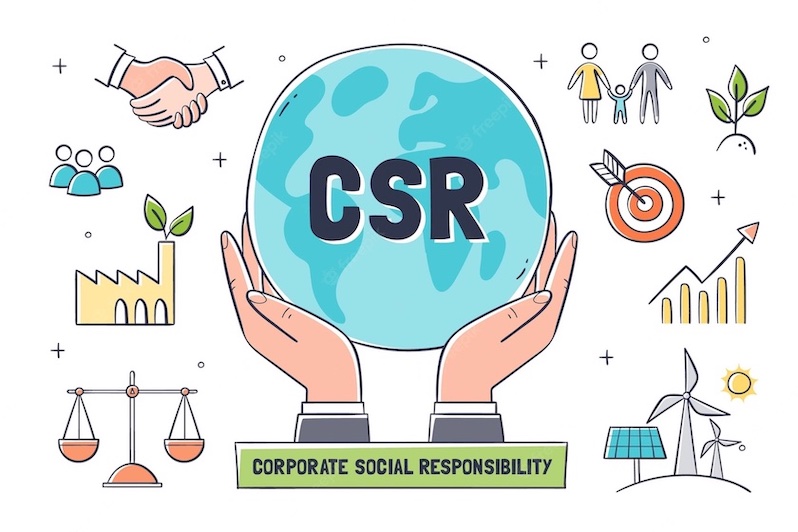
That’s where Corporate Social Responsibility (CSR) comes in. CSR is more than a law; it’s a moral compass that guides corporations to give back to the communities that helped them grow.
💡 What is CSR Fund?
CSR (Corporate Social Responsibility) Fund is the amount companies set aside from their profits to support social, environmental, and community development projects.
Under Section 135 of the Companies Act, 2013, the Indian government made CSR mandatory for eligible companies.
“We earn from society — we must give back to society.”
🏛️ Why Was CSR Fund Created?
The CSR framework was introduced to ensure that economic growth goes hand-in-hand with social welfare.
🎯 Objectives of CSR
| Objective | Description |
|---|---|
| Social Welfare | To uplift underprivileged communities through education, health, and livelihood projects. |
| Environmental Responsibility | To promote sustainability through clean energy and conservation. |
| Innovation Support | To encourage startups and innovators working on social impact solutions. |
| Nation Building | To contribute to rural infrastructure and disaster relief efforts. |
💰 Who Can Give CSR Funds?
According to the Companies Act, any company that meets any one of these criteria must spend at least 2% of its average net profits from the previous three years on CSR:
| Criteria | Threshold |
|---|---|
| Net Worth | ₹500 crore or more |
| Turnover | ₹1,000 crore or more |
| Net Profit | ₹5 crore or more |
These funds are directed toward CSR-approved activities listed under Schedule VII — health, education, sustainability, innovation, and more.
🙌 Who Can Receive CSR Funds?
CSR funds can be given to:
- Registered NGOs, Trusts, or Societies
- Section 8 Companies (non-profit organizations)
- Government Institutions / Research Bodies
- Innovators, Startups, and Incubators (aligned with CSR goals)
- Academic Institutions (working on social technology or research)
Important: To receive CSR funds, the entity must be registered under Form CSR-1 on the MCA (Ministry of Corporate Affairs) portal.
⚖️ Government Rules & Registration Process
| Rule / Step | Description |
|---|---|
| CSR Spending Rule | Minimum 2% of average net profit (past 3 years) |
| CSR Committee | Every company must form a CSR Committee to plan, monitor, and report projects |
| Form CSR-1 | NGOs or innovators must file this on MCA portal to be eligible |
| National CSR eXchange Portal | Register to list your project and get visibility to companies |
| Reporting | Companies must disclose CSR activities in their annual reports |
| Unspent Amounts | Must be transferred to a CSR-specific fund or account within 6 months |
🧭 Complete Process: How an Innovator Can Receive CSR Fund
| Step | Action | Description |
|---|---|---|
| 1. Legal Setup | Register your entity as a Trust / Society / Section 8 Company | Obtain 12A & 80G certificates for tax exemption |
| 2. CSR-1 Registration | File Form CSR-1 with MCA | Mandatory to receive CSR funds |
| 3. Prepare Proposal | Draft a detailed project proposal | Include innovation, beneficiaries, measurable outcomes, and budget |
| 4. Register on CSR eXchange | Upload project details on csrxchange.gov.in | Corporates discover and contact you directly |
| 5. Identify Suitable Corporates | Search companies aligned with your theme (e.g., environment, education) | You can find them via MCA or CSR portals |
| 6. Partner with an NGO / Incubator | If you are an individual innovator | It increases credibility and compliance |
| 7. Approach CSR Cells | Contact state CSR cells (like Telangana T-SIG, MCGM, etc.) | Submit proposal via official email/portal |
| 8. MOU & Fund Transfer | Once approved | CSR funds are transferred in tranches based on project milestones |
| 9. Implementation & Reporting | Execute project & send progress reports | Maintain transparency and documentation |
📍 Where to Register or Apply (Official Links)
| Authority / Portal | Purpose | Link / Contact |
|---|---|---|
| Ministry of Corporate Affairs (MCA) | File CSR-1 registration form | mca.gov.in |
| National CSR eXchange Portal | List your project for CSR funding | csrxchange.gov.in |
| Telangana CSR Cell (T-SIG) | Submit state-level CSR project | csr.telangana.gov.in |
| GHMC CSR Cell (Hyderabad) | Urban project proposals | csr-ghmc@telangana.gov.in |
| MCGM CSR Cell (Mumbai) | City-level CSR support | csrcell.mcgm@gmail.com |
| KREDL (Karnataka) | Energy & green innovation CSR projects | pd.webportal@karnataka.gov.in |
| NREDCAP (Andhra Pradesh) | Infrastructure & renewable projects | bg@nredcap.in |
🌟 Case Study: Tata Group’s CSR Impact
The Tata Group has been India’s CSR pioneer, consistently ranking among the highest spenders.
Their CSR projects include:
- Tata STRIVE: Vocational skill training for youth.
- Tata Trusts Health Program: Cancer care across India.
- Clean Water & Sanitation: Village-level filtration systems.
In 2023, Tata Group spent over ₹1,200 crore in CSR across 400+ districts — impacting millions of lives.
💪 How a Small Innovator Can Use CSR Fund
Imagine a young innovator who received the President’s Award for inventing a low-cost water purifier.
Here’s how they can scale it using CSR funds:
| Step | Action |
|---|---|
| Identify CSR companies focusing on water & sustainability | Search through CSR eXchange and MCA reports |
| Partner with local NGO or incubation center | Like T-Hub or Atal Incubation Centre |
| Submit proposal to CSR Cell | e.g., Telangana T-SIG or MCGM |
| Highlight President Award & Social Impact | Builds credibility with corporates |
| Implement pilot with CSR support | Deploy solution in rural areas |
| Document and report progress | Use reports, photos, testimonials |
“Innovation is not just invention — it’s impact.” — A.P.J. Abdul Kalam
🌿 Benefits of CSR (for Both Sides)
| Benefits to Companies | Benefits to Innovators & Society |
|---|---|
| Builds brand image & goodwill | Funding for impactful ideas |
| Enhances employee engagement | Helps scale social innovation |
| Strengthens community relations | Promotes sustainable development |
| Complies with legal norms | Recognition & partnerships |
⚠️ Challenges / Limitations
| Challenge | Description |
|---|---|
| Limited Awareness | Many innovators don’t know CSR eligibility steps |
| Paperwork & Legal Complexity | CSR-1 and documentation can be tedious |
| Corporate Alignment | Projects must fit company CSR theme |
| Delayed Disbursement | Approval and fund release may take time |
🧭 Government & Corporate Support for Innovators
| Support Type | Private Company Role | Government Role |
|---|---|---|
| Funding | CSR grants, incubation partnerships | Schemes under DST, MSME, NITI Aayog |
| Mentorship | Corporate experts guiding innovators | Technical mentors from incubation programs |
| Infrastructure | Labs, manufacturing, testing support | Access to govt. innovation labs & Atal Centres |
| Recognition | Featuring innovators in CSR reports | Awards, exhibitions, and patent assistance |
🌱 Conclusion: CSR as a Catalyst for Innovation
CSR is not just about compliance — it’s about compassion in action.
When corporate funding meets individual innovation, the result is transformational change.
“A single idea, funded and supported with purpose, can change a thousand lives.”
So, whether you are a young innovator, NGO founder, or social entrepreneur, CSR funds can help you scale your dream — responsibly, sustainably, and proudly for India.