
“A society is not progressive because it is modern. A society is progressive when it respects freedom, dignity, and mutual choice.”
When people talk about progress, they often imagine skyscrapers, technology, and modern lifestyles.
But sometimes, true progress is hidden deep within traditions that have existed for centuries.
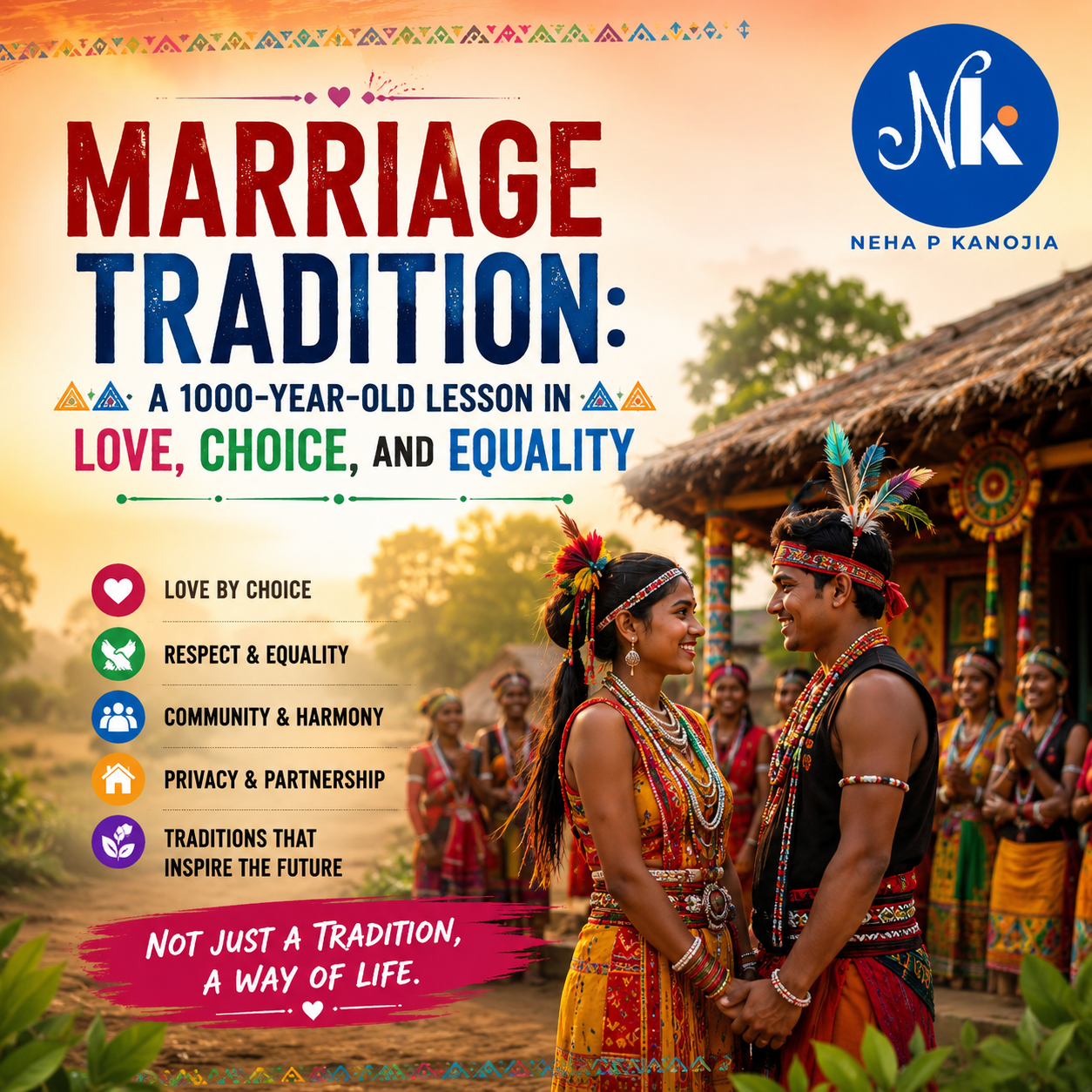
In the heart of Bastar, Chhattisgarh, lives the Muria tribe—a community whose marriage customs challenge many modern assumptions about love, relationships, and equality.
For over a thousand years, they have practiced a system that values mutual consent, personal choice, respect, and community harmony.
Ironically, while some people still claim that India has always been socially backward, the Muria tribe quietly demonstrates that progressive thinking existed here long before many modern societies began discussing concepts such as dating, consent, and individual freedom.
Their story deserves to be told.
The Ghotul: Where Love Meets Learning
At the center of Muria culture stands a remarkable institution known as the Ghotul.
More than a building, it is a social and cultural academy.
Every evening, unmarried boys and girls gather here.
Young men are known as Cheliks, and young women are called Motiaris.
But the Ghotul is not simply a place for social interaction.
It is where young people learn:
- Tribal traditions
- Community values
- Music and dance
- Responsibility
- Respect for others
- Social harmony
Most importantly, it allows young adults to know one another before marriage.
A Thousand-Year-Old System of Choice
In many societies, marriages have historically been arranged without the involvement of the bride or groom.
The Muria tradition took a different path.
Young men and women were free to interact, communicate, and understand each other’s personalities.
Relationships developed naturally.
At a time when many cultures restricted interaction between young men and women, the Murias recognized an important truth:
“A lifelong partnership should begin with understanding, not uncertainty.”
The Beautiful Tradition of the Wooden Comb
One of the most fascinating customs of the Muria tribe is the tradition of the carved wooden comb.
A young man who admires a woman carefully carves a wooden comb by hand.
Every design is unique.
Every pattern reflects effort, patience, and affection.
The comb is then gifted to the woman.
If she accepts it and wears it in her hair, she publicly expresses her choice.
No pressure.
No force.
No hidden negotiations.
Simply mutual consent.
Imagine the beauty of that gesture.
No expensive gifts.
No extravagant displays.
Just effort, sincerity, and respect.
Love Before Marriage Was Not a Crime
The Ghotul system acknowledges something many societies struggled to accept:
Young people naturally form emotional bonds.
Instead of suppressing this reality, the Muria community created a structured environment where relationships could develop responsibly.
This approach reduced secrecy and encouraged honesty.
The emphasis was not on control.
It was on trust.
When Families Disagreed
Like every society, disagreements sometimes occurred.
Not every family approved of every relationship.
In such situations, couples occasionally chose elopement.
The couple would temporarily leave and spend a few days away from the village.
Upon their return, the village council would mediate discussions between both families.
The goal was not punishment.
The goal was resolution.
This demonstrates an important cultural value:
“Community exists to support relationships, not destroy them.”
No Dowry, Only Respect
One of the most progressive aspects of Muria marriage traditions is the absence of dowry.
Instead, the Muria community follows a system often called Bride Price (Suk).
The groom’s family presents gifts, grains, and traditional items to the bride’s family.
This is not a purchase.
It is a gesture of appreciation and responsibility.
The bride is not treated as a burden.
She is valued as an important member of society.
Marriage Is a Celebration of Community
Once the marriage is accepted, the entire village celebrates.
The event includes:
- Traditional dances
- Folk music
- Community feasts
- Cultural performances
- Local brews and food
Marriage is not merely the union of two individuals.
It becomes a celebration of collective happiness.
A Lesson in Privacy and Independence
One of the most beautiful aspects of Muria marriage is what happens afterward.
The newly married couple builds a separate hut or living space near the groom’s family.
The family remains connected.
Meals may still be shared.
Support remains available.
But privacy is respected.
The couple is given space to grow independently while remaining part of the larger family network.
How remarkable is that?
Even centuries ago, they understood something many modern families still struggle with:
Love grows best where support and privacy coexist.
What Can Modern Society Learn?
The Muria tribe’s marriage culture teaches several timeless lessons:
| Muria Value | Modern Lesson |
|---|---|
| Mutual Choice | Relationships need consent |
| Courtship | Know your partner before marriage |
| No Dowry | Respect over transactions |
| Community Support | Families should guide, not control |
| Privacy After Marriage | Independence strengthens relationships |
| Equality | Partnership should be balanced |
Was India Really Backward?
This story raises an important question.
If a tribal community practiced:
- Consent
- Dating
- Individual choice
- Gender dignity
- Relationship freedom
- Privacy after marriage
for centuries…
Can we honestly say India lacked progressive social ideas?
Perhaps the problem is not that we have forgotten our traditions.
Perhaps we have forgotten to understand them.
India’s history is far richer, deeper, and more nuanced than stereotypes suggest.
The Muria tribe is proof of that.
My Reflection
What inspires me most about the Muria community is not just their marriage system.
It is their trust.
They trusted young people.
They trusted relationships.
They trusted individuals to make choices.
And that trust created a culture rooted in responsibility rather than fear.
In a world where relationships often become transactions, their traditions remind us that genuine partnership begins with mutual respect.
My Opinion
“True progress is not measured by how modern a society looks. It is measured by how much dignity, freedom, and respect it gives its people.”
For over a thousand years, the Muria tribe has quietly preserved a culture where love is chosen, consent is valued, privacy is respected, and community supports rather than controls.
Perhaps the future of relationships is not something we need to invent.
Perhaps it is something we need to remember.
Trusting the Next Generation:
While sharing the Muria tribe’s traditions, I am not suggesting that every society should change its customs or abandon its values. Every culture has its own journey, strengths, and challenges. However, I do believe there are some timeless lessons we can learn from communities like these.
One of the most powerful lessons is trusting the younger generation.
Today, we proudly call ourselves educated, modern, and progressive. Yet, many of us hesitate to give young people the responsibility to make important decisions. The truth is, until we allow them to make choices, they will never learn how to make the right ones.
As parents and elders, our role is not to control every step of their journey but to guide them, support them, and stand beside them when they need us. Wisdom grows through experience, and experience comes from responsibility.
In today’s world, many children are being protected so much that they become dependent on their parents for even the smallest day-to-day decisions. While love and care are important, overprotection can sometimes limit confidence, independence, and decision-making abilities.
Nature teaches us this lesson beautifully.
A mother bird lovingly protects her chicks, feeds them, and nurtures them. But when the time comes, she encourages them to leave the nest and fly on their own. If birds never allowed their young ones to take that leap, perhaps no bird would ever learn to fly.
The same applies to us.
If we want our children to become confident, responsible, and capable individuals, we must gradually trust them with responsibility. We may not always agree with every choice they make, but we can ensure they know they have a family standing behind them.
After all, the goal of parenting is not to raise children who depend on us forever. The goal is to raise individuals who can stand strong on their own while carrying the values we taught them.
“The greatest gift parents can give their children is not protection from every mistake, but the confidence to face life and learn from their own experiences.”