
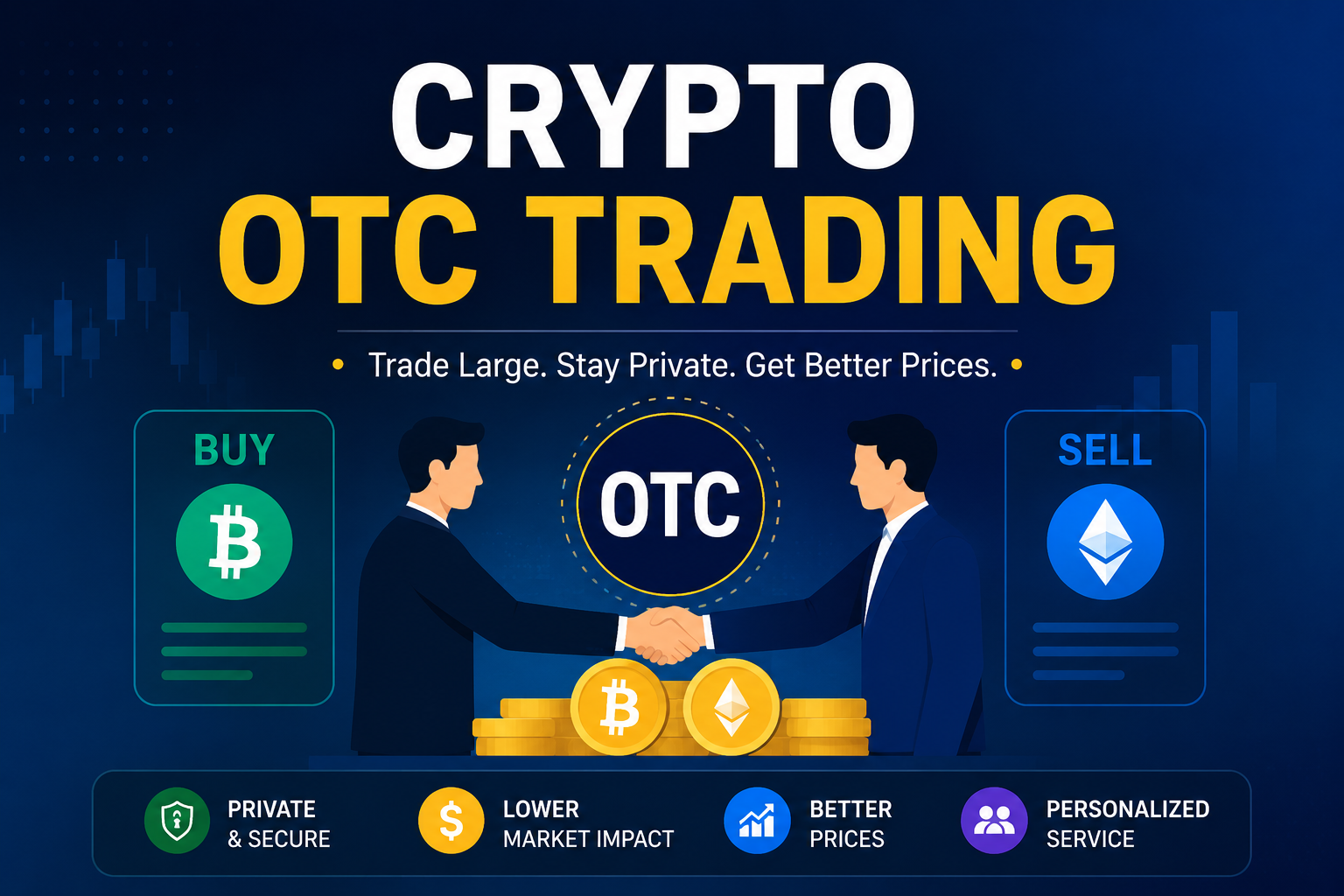
“In crypto, large trades are not just about buying and selling — they are about strategy, timing, privacy, and minimizing market impact.”
Many people use normal crypto exchanges to buy and sell coins. But imagine buying millions of rupees worth of Bitcoin or cryptocurrency at once.
What happens?
The market price may suddenly move, your trade may execute at different prices, and you may end up paying more than expected.
This is where OTC (Over-The-Counter) Crypto Trading becomes important. The uploaded content explains how OTC trading works and why large traders prefer it.
What Is OTC Crypto Trading?
OTC (Over-The-Counter) crypto trading means:
👉 Buying or selling cryptocurrency directly between two parties without using a public exchange order book.
Instead of placing orders publicly:
- Buyers and sellers connect through OTC desks
- Price is discussed and agreed beforehand
- Large trades happen privately
This helps traders avoid sudden market movements.
Example
Imagine:
Situation 1 – Normal Exchange
You want to buy:
💰 ₹50 Crore worth of Bitcoin
Result:
❌ Market price starts increasing
❌ Order executes at different prices
❌ Higher buying cost
Situation 2 – OTC Trading
You contact an OTC desk:
✔ Price discussed beforehand
✔ Trade fixed privately
✔ Trade completed smoothly
Why Large Traders Prefer OTC Trading
Benefits of OTC Trading
| Benefit | Simple Meaning |
|---|---|
| 📉 Reduced Slippage | Price doesn’t change suddenly |
| 🔒 Privacy | Trading details remain confidential |
| 💧 Deep Liquidity | Large trades execute smoothly |
| ⚡ Better Pricing | Pre-agreed prices |
| 🎯 Flexible Orders | Traders choose trade conditions |
Large investors, institutions, and crypto whales usually prefer OTC trading because of these advantages.
Step-by-Step Guide: How OTC Trading Works
Step 1️⃣: Send Buy/Sell Request
Trader contacts OTC desk and shares:
- Asset name
- Quantity
- Expected timeline
Example:
“I want to buy 100 Bitcoin within two days.”
Step 2️⃣: Price Discussion
OTC desk analyzes:
✔ Market conditions
✔ Liquidity
✔ Current pricing
Then price discussions happen.
Step 3️⃣: Agreement & Price Lock
Both parties agree:
- Final price
- Trade terms
- Timeline
Now the price becomes fixed.
This protects traders from sudden market changes.
Step 4️⃣: Settlement
Funds and crypto are transferred according to agreed conditions.
Trade completes securely.
OTC Trading vs Exchange Trading
| Feature | OTC Trading | Exchange Trading |
|---|---|---|
| Pricing | Private negotiation | Market-based |
| Liquidity | Deep liquidity | Exchange liquidity only |
| Privacy | High | Public |
| Trade Size | Large trades | Small-medium trades |
| Market Impact | Very low | Can move market price |
| Best For | Institutions & whales | Retail users |
Risks & Challenges in OTC Trading
OTC trading has advantages, but traders should also understand risks.
| Risk | Explanation |
|---|---|
| ⚖ Compliance Risk | Must follow KYC & AML rules |
| 💸 Settlement Risk | Delays can affect trust |
| 🔧 Operational Risk | Platform failures can impact trades |
| 🔍 Low Transparency | Trade data is private |
🛡️ Step-by-Step Guide: How to Choose a Good OTC Platform
✔ Step 1: Check Liquidity
Choose a platform with strong liquidity support.
✔ Step 2: Check Reputation
Look for:
- User trust
- Market presence
- Reliability
✔ Step 3: Verify Security
Security should include:
- Cold wallet storage
- Encryption
- Secure settlements
✔ Step 4: Check Compliance
Platform should follow:
✔ KYC
✔ AML
✔ Legal regulations
✔ Step 5: Understand Fees
Read:
- Spreads
- Hidden charges
- Service fees
How To Start Your OTC Trading Journey
| Step | Action |
|---|---|
| 1️⃣ | Understand trade size requirements |
| 2️⃣ | Select trusted OTC platform |
| 3️⃣ | Complete KYC |
| 4️⃣ | Discuss pricing and execution process |
| 5️⃣ | Start trading carefully |
My Opinion
“Retail traders watch the market. Smart large investors learn how to move within the market.”
OTC trading is designed for people handling large volumes and seeking:
✔ Better pricing
✔ Privacy
✔ Faster execution
✔ Less market impact
It may not replace traditional exchanges, but for large transactions, it provides a more strategic approach.