
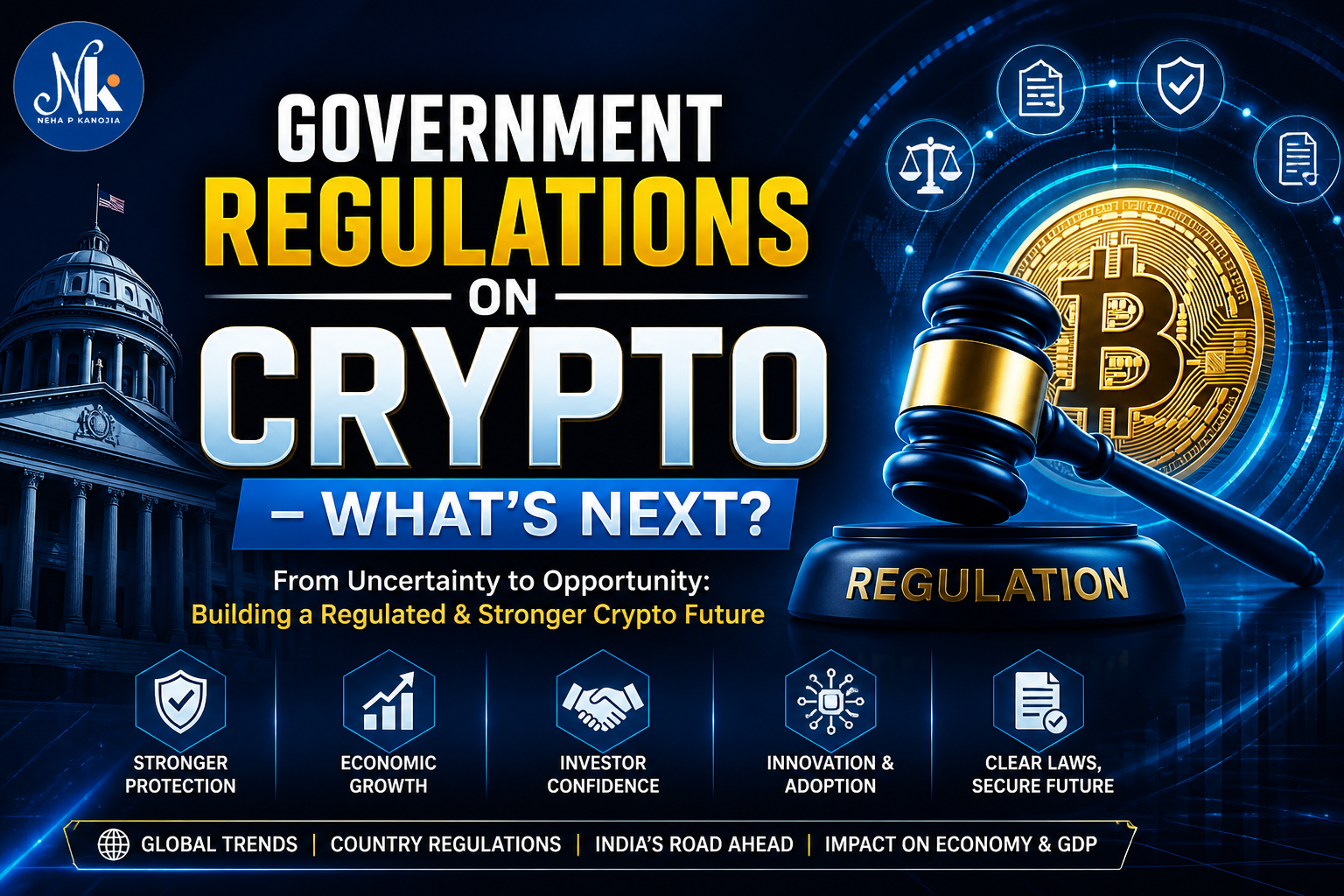
From Uncertainty to Opportunity: The Global Shift Toward Crypto Regulation
Cryptocurrency has moved far beyond being just a “digital experiment.” Today, it sits at the intersection of finance, technology, and policy. Governments worldwide are no longer ignoring it—they’re trying to regulate, control, and integrate it.
But the big question is:
👉 What’s next for crypto regulations globally—and especially in India?
Let’s break it down simply, logically, and with real-world facts.
Why Governments Are Regulating Crypto
Initially, crypto was seen as:
- Risky
- Uncontrolled
- Anonymous
Now governments see :
Opportunities
- Innovation in finance
- Faster cross-border payments
- Digital economy growth
👉 Regulation is not about stopping crypto.
👉 It’s about controlling and benefiting from it.
Countries That Have Regulated Crypto
Here are some major countries that have taken clear steps:
| Country | Regulation Status | Key Benefits |
|---|---|---|
| 🇺🇸 United States | Partially regulated | Investor protection, taxation clarity |
| 🇯🇵 Japan | Fully regulated | Safe crypto exchanges, mass adoption |
| 🇸🇬 Singapore | Strong regulation | Crypto hub for startups |
| 🇦🇪 UAE | Pro-crypto laws | Attracting global investors |
| 🇪🇺 European Union | MiCA regulation framework | Unified crypto policy across countries |
| 🇨🇭 Switzerland | Crypto-friendly | Known as “Crypto Valley” |
| 🇸🇻 El Salvador | Bitcoin as legal tender | Financial inclusion, global attention |
What These Countries Gained
After regulation, these nations saw:
- Increase in crypto investments
- Growth of blockchain startups
- Higher tax revenues
- Global recognition as innovation hubs
👉 Example: UAE & Singapore became global crypto centers.
Countries Moving Toward Regulation
More than 100+ countries are now:
- Drafting crypto laws
- Testing CBDCs (Central Bank Digital Currency)
- Creating compliance frameworks
Examples:
- India
- UK
- Australia
- Brazil
- South Korea
👉 The world is moving toward regulated adoption, not banning.
India’s Current Crypto Status
India has taken a balanced but cautious approach.
Current Situation:
- Crypto is not illegal
- Not fully regulated either
- 30% tax on crypto profits
- 1% TDS on transactions
👉 This shows:
Government is not banning crypto
But is monitoring and controlling it
What India Might Do Next
India is likely to:
- Introduce structured crypto regulations
- Strengthen compliance rules
- Launch Digital Rupee (CBDC)
- Align with global frameworks
👉 India is waiting for global clarity before full regulation
How Crypto Regulation Can Benefit India
If India regulates crypto properly, it can:
Economic Growth
- Boost digital economy
- Increase fintech innovation
- Attract global investments
Job Creation
- Blockchain developers
- Crypto analysts
- Web3 startups
Government Revenue
- Tax collection from transactions
- Regulated exchanges
Impact on GDP (Future Possibility)
| Factor | Impact on India |
|---|---|
| Crypto Investments | Increased capital inflow |
| Blockchain Adoption | Boost to tech sector |
| Tax Revenue | Higher government income |
| Startup Growth | Innovation ecosystem |
👉 Experts believe crypto + blockchain could contribute significantly to India’s digital GDP in coming years.
The Reality Check
Regulation must be:
✔ Balanced
✔ Innovation-friendly
✔ Risk-controlled
Too strict → Innovation dies
Too loose → Risks increase
👉 The goal is smart regulation, not restriction
My Opinion
Crypto is not going away.
It’s evolving.
Governments are realizing:
👉 You can’t stop it
👉 You can only shape it
Conclusion
- Crypto regulation is becoming global reality
- Countries that regulate early are benefiting more
- India is moving slowly—but strategically
- The future lies in regulated crypto ecosystems