
The Invisible Engine That Keeps Blockchain Trustworthy
When we talk about blockchain, we often hear words like Bitcoin, Ethereum, staking, or mining.
But there is one powerful system working silently behind the scenes — and that is called a Consensus Mechanism.
Without it, blockchain simply cannot function.
Let’s understand it in the simplest way possible.
Simple Definition
A consensus mechanism is the method a blockchain network uses to agree that a transaction is valid.
In simple words:
👉 It is the system that helps everyone in the network say,
“Yes, this transaction is correct.”
Since blockchain has no central authority (like a bank), it needs a way for thousands of computers to agree on the same data.
That agreement process is called consensus.
Why Do We Need Consensus?
In traditional banking:
• The bank verifies transactions
• The bank maintains records
• The bank decides what is valid
But in blockchain:
• There is no bank
• No central controller
• No single authority
So how does everyone agree?
That’s where consensus mechanism comes in.
Example
Imagine a classroom with 50 students.
There is no teacher.
Every student writes transactions in a shared notebook.
Now suppose one student writes:
“I received ₹10,000 from Rahul.”
Before accepting it, the other students must check:
• Did Rahul actually send it?
• Does Rahul have enough balance?
• Is the transaction valid?
If most students agree it’s correct → it gets approved.
If they disagree → it is rejected.
This agreement process is consensus.
No teacher.
No central authority.
Only group agreement.
That is exactly how blockchain works.
How Consensus Works in Blockchain
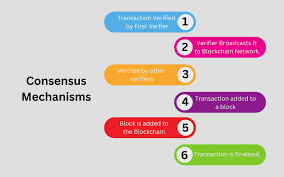
Here’s what happens step by step:
1️⃣ A transaction is requested
2️⃣ Network participants verify it
3️⃣ They check rules and balances
4️⃣ If majority agrees → transaction is added to blockchain
This process repeats for every block of transactions.
Main Types of Consensus Mechanisms
Different blockchains use different systems.
Let’s understand the most common ones.
Proof-of-Work (PoW)
Used by: Bitcoin
How it works:
• Miners solve complex mathematical problems
• First one to solve gets reward
• Very secure but energy-intensive
Example:
Like a competition where thousands try to solve a puzzle.
Whoever solves it first wins.
Proof-of-Stake (PoS)
Used by: Many modern blockchains including Beldex
How it works:
• Users lock (stake) coins
• Validators are selected
• They verify transactions
• They earn rewards
Example:
Imagine a society where members deposit security money to become guards.
Those who deposit are chosen to maintain order and get paid.
PoS is more energy-efficient and scalable.
What About Random Selection?
Some blockchains upgrade to systems like VRF (Verifiable Random Function).
This means:
• Validator selection becomes random
• Harder to manipulate
• More secure and decentralized
Think of it like:
Instead of manually choosing a class monitor,
A transparent lottery selects one randomly.
Fair. Secure. Trustworthy.
Why Consensus Mechanism Is Important
Consensus ensures:
• No double spending
• No fake transactions
• No central control
• Network security
• Trust in the system
Without consensus, blockchain would collapse.
It is the backbone of decentralization.
Consensus mechanism is the rulebook that allows a decentralized network to agree without needing a boss.
Why It Matters for the Future
As digital transactions increase globally, we need systems that:
• Are secure
• Do not rely on one authority
• Cannot be easily manipulated
• Work globally
Consensus mechanisms make that possible.
They are the silent engine behind blockchain innovation.
Opinon
Next time you hear about crypto or blockchain, remember:
It’s not just about coins.
It’s about how thousands of computers agree —
securely, fairly, and without a central authority.
That agreement system is called
Consensus Mechanism.