
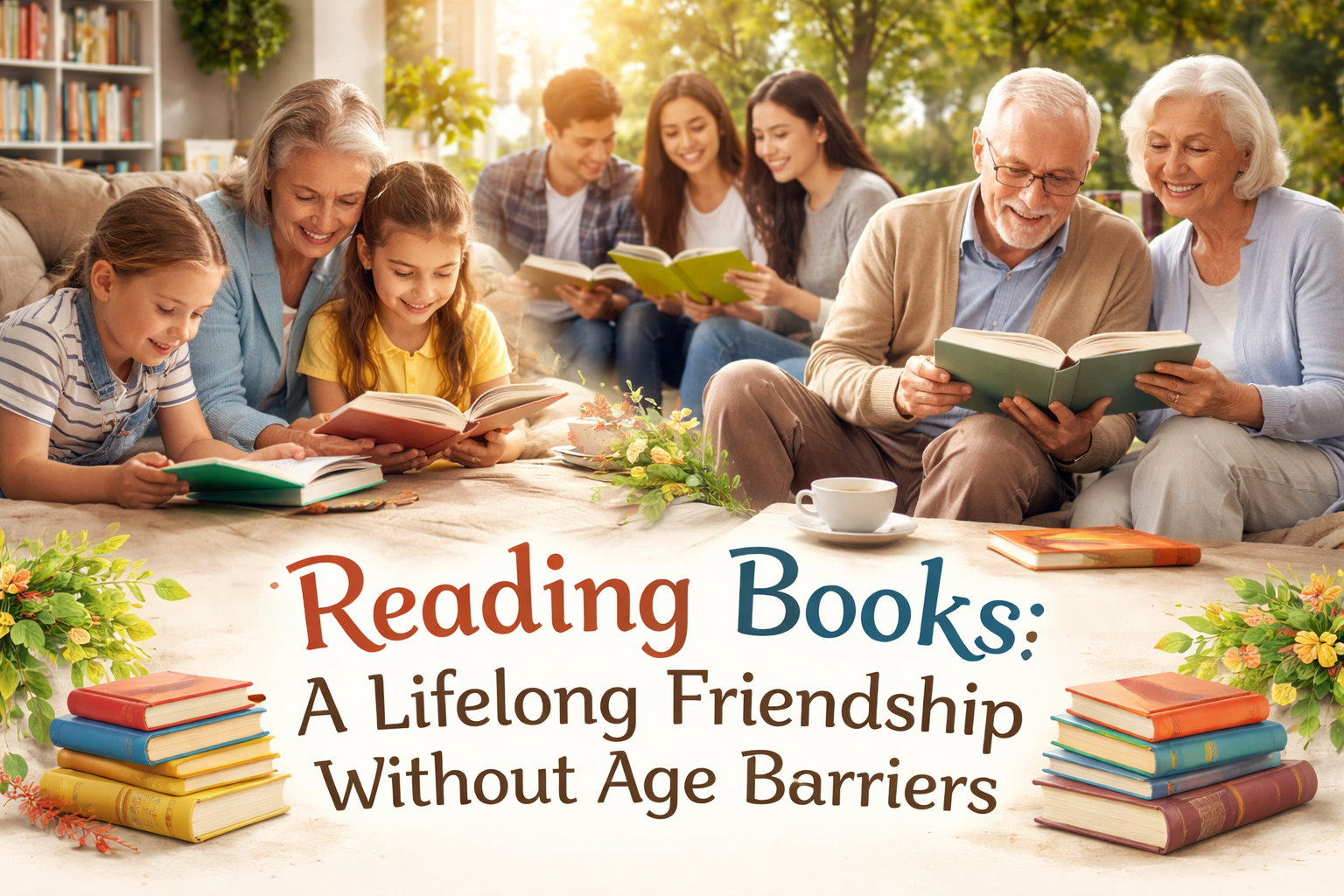
Reading books should be a natural part of life—there is no age barrier for reading. However, when friendship with books begins at a young age, it shapes thinking, emotions, and character for a lifetime. Books quietly guide us, teach us empathy, sharpen our minds, and nurture our inner world in ways no other medium can fully replace.
Why Reading Books Is Important
- Builds strong thinking and reasoning skills
- Improves language, vocabulary, and communication
- Develops imagination and creativity
- Encourages focus, patience, and discipline
- Strengthens emotional intelligence and empathy
- Creates lifelong learning habits
- Provides calmness and mental balance
Benefits of Reading on the Mind
- Enhances memory and concentration
- Strengthens neural connections in the brain
- Improves analytical and critical thinking
- Reduces stress and mental fatigue
- Slows age-related cognitive decline
📌 Research in neuroscience shows that deep reading activates multiple areas of the brain responsible for language, imagination, and emotional understanding.
Benefits of Reading on the Heart
- Builds empathy by understanding others’ emotions
- Helps children and adults process feelings safely
- Reduces anxiety and emotional stress
- Creates inner peace and self-awareness
- Encourages compassion and kindness
Benefits of Reading on the Body & Health
- Lowers stress levels, which helps heart health
- Improves sleep when reading replaces screen time
- Reduces eye strain compared to digital screens
- Supports better posture and relaxation
- Helps regulate breathing and calm the nervous system
📌 Studies show reading can reduce stress by up to 60%, even more effectively than listening to music or walking.
Why Reading Books Is Better Than Reading on Computers
| 📖 Books | 💻 Screens |
|---|---|
| Deep focus and comprehension | Distracting notifications |
| Better memory retention | Skimming and shallow reading |
| Less eye strain | Blue light affects sleep |
| Emotional connection | Reduced imagination |
| Calm and immersive | Mental fatigue |
📌 Printed books encourage deep reading, while screens promote fast, surface-level consumption.
What Experts Say About Reading
Maria Montessori
“The child who reads becomes the adult who thinks.”
Her work emphasized early exposure to books to develop independence, curiosity, and intelligence.
Dr. Daniel Siegel
A renowned neurologist, he highlights that reading strengthens brain integration, helping children regulate emotions and improve attention.
Maryanne Wolf
Her research shows that deep reading builds empathy, critical thinking, and emotional intelligence, which are weakened by excessive screen use.
Albert Einstein
“Imagination is more important than knowledge.”
Einstein credited books and reading for developing imagination, which he believed was the foundation of innovation.
Psychologists’ View
Child psychologists agree that children who grow up with books:
- Have better emotional control
- Perform better academically
- Develop stronger moral values
- Show higher self-confidence
My Opinion
Reading books is not just a habit—it is a way of life.
When children make friends with books early, they gain a lifelong companion that nurtures their mind, heart, body, and soul. In a fast digital world, books remain a quiet power—shaping thoughtful humans, compassionate hearts, and healthy minds.
📖 A child who reads today becomes a leader, thinker, and balanced human tomorrow.
If your heart believes in the power of books, values, and lifelong learning, URM Reading Hub warmly welcomes you.
Come be part of a living community where knowledge touches the heart and ignites a Second Freedom.
📩 Reach us: ASK@VMOHAN.IN
📞 Call: +91 99497 01855
Because every meaningful journey begins with a single connection—and a love for reading.