
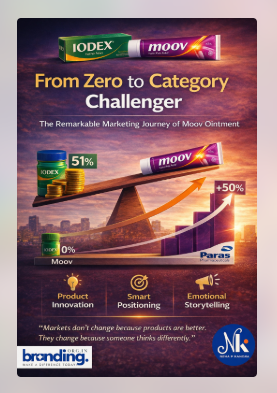
How smart positioning, bold innovation, and emotional storytelling disrupted a market ruled by giants
“Markets don’t change because products are better.
They change because someone thinks differently.”
This is the story of Moov Ointment — a brand that entered a crowded, conservative market and rewrote the rules of pain-relief branding in India.
🧠 The Market Before Moov: A Giant Named Iodex
Before Moov entered the scene, the Indian pain-relief ointment market was firmly ruled by Iodex.
| Brand | Market Situation (Pre-Moov Era) |
|---|---|
| Iodex | ~51% market share, household name |
| Others (Amrutanjan, Zandu, etc.) | Fragmented, traditional players |
| Consumer perception | Pain balm = dark, smelly, sticky |
| Packaging norm | Glass jars & tins |
Pain relief was seen as:
- Old-fashioned
- Medicinal
- Something your grandparents used
There was no excitement, no differentiation, no emotional connect.
And then… Moov arrived.
⏳ The Beginning (1986): A Small Brand with a Big Insight
Moov was launched in 1986 by Paras Pharmaceuticals Ltd.
At launch:
- Market share: ~0.3%
- Brand awareness: Negligible
- Competition: Extremely strong
So the question was not:
“How do we beat Iodex?”
The real question was:
“How do we change how people think about pain relief?”
💡 The First Breakthrough: Reimagining the Product Itself
🧴 Innovation #1: The Tube Changed Everything
Moov became one of the first brands in India to introduce pain relief in a tube.
Why did this matter?
| Traditional Jars | Moov Tube |
|---|---|
| Messy & unhygienic | Clean & modern |
| Difficult to carry | Easy to use anywhere |
| Looked medicinal | Looked lifestyle-friendly |
| Black, sticky paste | White, fragrant cream |
🔧 Behind the scenes:
To make this possible, the founder imported specialized tube-filling machinery from Germany — a bold and expensive decision at that time.
This wasn’t just packaging.
It was perception engineering.
🎯 The Masterstroke: Positioning as a “Backache Specialist”
While competitors said:
“We relieve all kinds of pain”
Moov said:
“We are for back pain.”
Why back pain?
- It’s frequent, not occasional
- It affects homemakers, workers, professionals
- It creates repeat usage
🎯 Strategic Shift:
| Generic Balm | Moov |
|---|---|
| All pains | Back pain focus |
| Occasional use | Everyday relevance |
| No clear identity | Clear specialist image |
This single decision gave Moov a sharp identity in a cluttered market.
📢 Advertising That Told a Story, Not Just a Claim
Moov didn’t shout louder.
It spoke smarter.
⏰ Advertising Timeline
| Period | Campaign | What It Did |
|---|---|---|
| Early 1990s | “Aah se Ahaa Tak” | Visualized pain-to-relief journey |
| Late 1990s | Heat & warmth messaging | Built sensory association |
| 2000s | “1 Minute Moov Ki Maalish” | Emphasized speed & ease |
| Later years | Self-application & spray ads | Expanded usage moments |
These ads showed:
- Everyday people
- Everyday pain
- Everyday relief
Moov didn’t sell medicine.
It sold comfort and dependability.
🛒 Market Placement: Winning the Shelf and the Mind
Moov focused aggressively on distribution:
- Strong presence in chemist stores
- Expansion into general retail
- High shelf visibility due to tube design
- Sales teams pushing availability across urban & semi-urban markets
The tube stood out visually — even next to dominant brands.
📊 The Numbers Tell the Story
📈 Market Impact Over Time
| Parameter | Before Moov | After Moov’s Rise |
|---|---|---|
| Market leader dominance | Iodex ~51% | Reduced over time |
| Moov market share | ~0.3% | Significant category player |
| Consumer perception | Balm = old | Balm = modern & usable |
| Usage frequency | Occasional | Regular / habitual |
Moov didn’t just gain share.
It expanded the category usage.
⚔️ Moov vs Iodex: A Comparator Chart
| Aspect | Iodex | Moov |
|---|---|---|
| Entry era | Legacy brand | Challenger |
| Packaging | Glass jar | Tube (later spray) |
| Positioning | General pain relief | Backache specialist |
| Advertising tone | Traditional | Relatable & emotional |
| Innovation | Slow | Bold & early |
| User perception | Old-school | Modern & convenient |
🧠 Why Moov Succeeded: The Real Reasons
- Product innovation driven by insight, not trend
- Focused positioning instead of broad claims
- Consistent storytelling across decades
- Packaging as a marketing weapon
- Understanding usage frequency, not just pain type
Moov didn’t fight the leader head-on.
It changed the battlefield.
🌟 The Bigger Lesson for Brands
Moov proves that:
- You don’t need to be first
- You don’t need the biggest budget
- You don’t need to copy the leader
You need:
One sharp insight + courage to execute it fully
🏁 Conclusion: From Ointment to Icon
Moov’s journey is not just about pain relief.
It’s about market disruption through clarity.
From:
- 0.3% share
- To challenging a 51% market leader
- By changing packaging, positioning, and perception
Moov became a case study in Indian marketing excellence.
When brands stop copying and start understanding consumers —
markets move. Just like Moov did.