
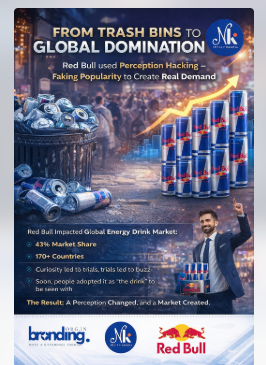
“People don’t follow products. They follow what they believe everyone else is choosing.”
Before Red Bull became a global icon, before it sponsored extreme sports, Formula 1, and record-breaking stunts, its marketing was not glamorous.
It was scrappy, clever, and psychological.
This is not just a branding story.
This is a masterclass in perception, human behavior, and market creation.
🕰️ When Did Red Bull Start?
- Founded: 1987
- First Market Launch: Austria (1987)
- UK & Europe Expansion: Early–mid 1990s
- Global Expansion: Late 1990s onward
The energy drink category did not exist in the West before Red Bull. They didn’t enter a market — they created one.
👤 Who Started Red Bull?
🔹 Dietrich Mateschitz
- An Austrian marketing executive
- Worked at Unilever before Red Bull
- Visionary behind the brand, positioning, and marketing philosophy
- Owned 49% of the company
🔹 Chaleo Yoovidhya
- Thai entrepreneur
- Creator of Krating Daeng (a local Thai energy drink)
- Partnered with Mateschitz
- Owned 51% of the company
👉 Mateschitz discovered Krating Daeng during a business trip to Thailand and noticed it helped him recover from jet lag. He saw its global potential, reformulated it for Western tastes, and built a brand around it.
💡 Who Came Up With the “Trash Bin” Branding Idea?
The famous “empty Red Bull cans in trash bins” tactic was:
- Developed by Red Bull’s early European/UK marketing teams
- Executed in the early 1990s, especially in the UK nightlife scene
- Fully aligned with Dietrich Mateschitz’s marketing philosophy
📌 Important clarity:
This idea is not credited to a single named individual, but to Red Bull’s in-house guerrilla marketing culture, personally encouraged and approved by Mateschitz.
🗑️ The Unusual Beginning: Marketing from the Garbage
When Red Bull first entered the UK market, it had three big problems:
- No one knew what an energy drink really was
- The taste was unfamiliar
- There was no existing demand
So instead of spending millions on ads, Red Bull did something radical.
👉 They filled trash bins across London with empty Red Bull cans
Outside:
- Nightclubs
- College campuses
- Party hotspots
The message wasn’t spoken.
It was seen.
People walking by subconsciously thought:
“Everyone is drinking this. I must be missing out.”
That’s when curiosity kicked in.
And curiosity creates trial.
🧠 This Was Not Marketing. This Was Perception Hacking.
Red Bull didn’t try to convince people with claims.
They created social proof.
Humans are wired to follow the crowd.
If something looks popular, we assume it must be good.
Red Bull used:
- Scarcity
- Social validation
- FOMO (Fear of Missing Out)
All without saying a single word.
📊 Before vs After: The Branding Shift That Changed Everything
| Aspect | Before This Strategy | After This Strategy |
|---|---|---|
| Brand Awareness | Almost zero | “Everyone seems to drink it” |
| Consumer Perception | Confusing, unfamiliar | Trendy, urban, must-try |
| Demand | Non-existent | Curiosity-driven demand |
| Marketing Spend | Very low | Massive ROI |
| Market Position | New, risky product | Cultural phenomenon |
This one tactic helped Red Bull enter conversations before entering carts.
🚀 What Happened Next: Turning a Drink into a Lifestyle
Once people started trying it, Red Bull didn’t stop.
They doubled down on identity-based branding:
- Extreme sports
- Nightlife culture
- Music, racing, adventure
- “Gives You Wings” wasn’t about energy — it was about possibility
Red Bull didn’t sell a beverage.
They sold a state of mind.
🌍 The Results Speak Louder Than Ads
Today:
- Red Bull owns ~43% of the global energy drink market
- Operates in 170+ countries
- Sponsors Formula 1 teams, athletes, creators
- Is studied in business schools as a branding legend
📌 Not bad for a brand that started in garbage bins.
💡 The Branding Lessons Every Business Must Learn
1️⃣ Perception Comes Before Product
People buy what looks trusted before they test quality.
2️⃣ Social Proof Beats Advertising
If people think others are using it, they follow.
3️⃣ You Don’t Need Money — You Need Insight
Understanding human psychology > Big budgets.
4️⃣ Brands Are Built in the Mind First
Sales come later.
📖 An Imaginary Modern Case Study (If This Happened Today)
Imagine a new fintech or health startup today.
Instead of ads, you see:
- Screenshots of app usage on café tables
- Empty coffee cups with the brand logo everywhere
- People casually mentioning it in coworking spaces
No ads shouting.
Just presence.
You’d assume:
“This must already be big.”
That’s Red Bull thinking — applied anywhere.
🧭 My Take (Business Boosters Perspective)
Red Bull proves one powerful truth:
Marketing is not about being loud.
It’s about being believable.
Great branding doesn’t beg for attention.
It plants ideas.
If you’re building a business today:
- Stop asking “How do I sell more?”
- Start asking “How do I look already chosen?”
That’s where growth begins.
✨ WE CAN HELP
“The most powerful brands don’t shout.
They make you believe everyone else already chose them.”
💼 Business Boosters ✅
Build perception. The market will follow.
Book Appointment : https://calendar.app.google/GJhKgaDfLWJz1sZK7