
Interested to Attain fill this form: https://app.formberry.io/en/BlockchainforWomen check this once
“When trust in institutions wavers, technology builds a new kind of trust — one written in code.”
🌾 Chapter 1: When Trust Was the Currency
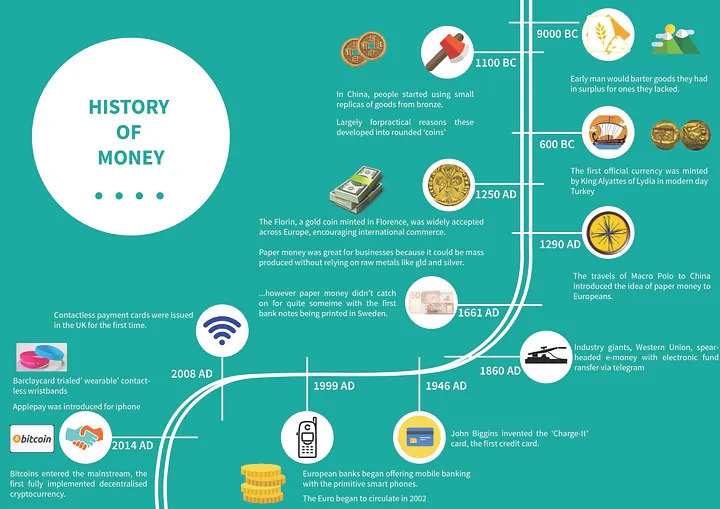
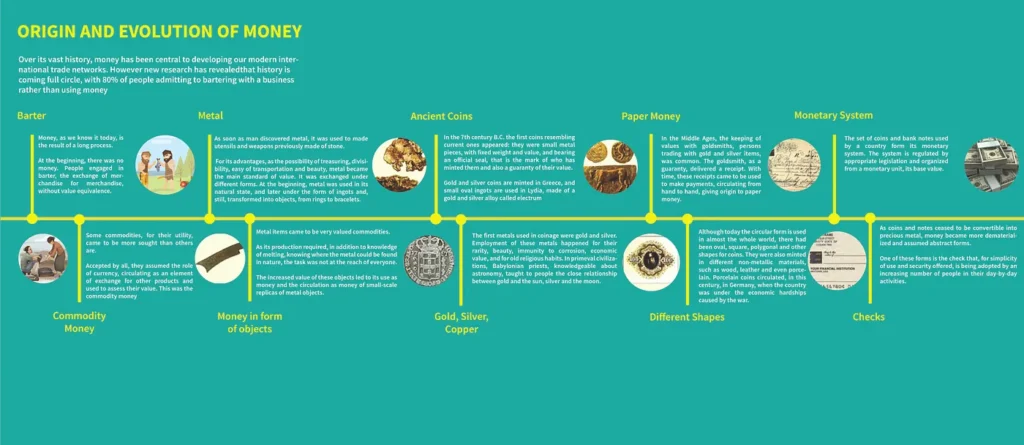
Long before banks or wallets existed, India’s economy thrived on barter.
In rural villages, people exchanged goods — rice for wheat, milk for cloth, labour for grain.
A farmer from Punjab might trade sacks of wheat with a weaver from Gujarat for cotton cloth.
There were no coins, no notes — only trust and mutual need.
But barter had its challenges:
What if the weaver didn’t need wheat today? Or what if the farmer wanted salt instead?
And thus began humanity’s search for a universal medium of exchange.
🪙 Chapter 2: When Gold and Silver Became “God’s Money”
To solve barter’s problems, Indians — like much of the ancient world — began trading in gold and silver coins.
These metals were valuable, durable, and trusted across kingdoms.
From Mauryan punch-marked coins to the Mughal silver rupee, India’s markets glittered with metal money.
Gold wasn’t just wealth — it was security. Even today, Indian households hold over 25,000 tonnes of gold — more than any central bank in the world.
But carrying gold was risky and inconvenient.
So rulers began issuing paper promissory notes, backed by royal treasuries.
The story of money had entered a new chapter — from metal to paper.
💰 Chapter 3: The Birth of the Indian Rupee
With the British came the Indian Rupee — standardized, printed, and regulated.
After independence, the Reserve Bank of India (RBI) became the guardian of trust, ensuring that every ₹500 note you held had value.
When you paid ₹53 for a pair of shoes, it wasn’t the paper that mattered — it was the promise printed on it:
“I promise to pay the bearer the sum of…” — Governor, Reserve Bank of India.
Money had now become trust on paper.
But as India moved towards modernization, cash slowly gave way to something new — digital money.
📱 Chapter 4: The Age of Digital India
Fast forward to today — a world of UPI, Google Pay, Paytm, and PhonePe.
You no longer hand over cash — just tap a button, and the money “magically” transfers.
But what really happens behind the screen?
When you pay ₹53 to your local shoe shop using Google Pay:
| Step | Process | Who Controls It |
|---|---|---|
| 1 | You press Pay ₹53 | You |
| 2 | Your bank verifies your balance | Your Bank |
| 3 | Bank debits ₹53 from your account | Bank |
| 4 | Bank credits ₹53 to the shopkeeper’s account | Bank |
| 5 | Both entries are stored in the Bank’s ledger | Bank |
Everything works fine — but notice one thing:
The entire system depends on the bank’s central ledger.
If that server crashes, your transaction fails.
If the bank freezes your account, your money is locked.
We have convenience, but we’ve lost control.
So here comes the next question —
Can India build a system where we can transfer value without middlemen?
💡 Chapter 5: The Rise of Cryptocurrency
That’s where Bitcoin and Blockchain enter the story — a new chapter in how we understand money.
“What if money could verify itself — without a bank, without a government, just through trustless technology?”
Bitcoin replaces the central ledger with a distributed network —
where thousands of computers (called nodes) maintain the same record of every transaction.
Every page of that record is a Block.
Each block links to the previous one using cryptography — forming a Blockchain.
Once a transaction is added, it can’t be changed or deleted.
It’s like carving history in digital stone.
Let’s revisit the same shoe purchase — this time using Bitcoin.
👟 Chapter 6: Buying Shoes the Crypto Way
Imagine you want to pay 0.001 BTC (≈ ₹53) to your local cobbler.
Here’s how it works:
| Step | Action | Who Performs It |
|---|---|---|
| 1 | You broadcast your transaction: “I’m sending 0.001 BTC to the cobbler.” | You |
| 2 | It goes to the Bitcoin network — everyone can see it. | Global network |
| 3 | Miners verify you have enough balance. | Miners |
| 4 | Valid transactions are added to a new block. | Miners |
| 5 | Miners solve a cryptographic puzzle (Proof of Work). | Competing miners |
| 6 | The winner adds the block to the blockchain and gets rewarded. | Blockchain |
| 7 | The cobbler receives Bitcoin — securely and transparently. | Network ledger |
No banks.
No UPI servers.
No RBI — just math, code, and community trust.
Your payment is now part of a digital history that anyone can verify — but no one can alter.
🔗 Chapter 7: Evolution of Money — The Indian Timeline
| Era | Type of Money | Medium | Who Controls It | Example | Key Limitation |
|---|---|---|---|---|---|
| Ancient (Before 600 BCE) | Barter System | Goods | Individuals | Wheat for Rice | Hard to match needs |
| Mauryan to Mughal Period | Metal Money | Gold, Silver | Rulers | Punch-marked coins | Heavy, unsafe |
| British Raj (1835–1947) | Paper Currency | Notes | British Govt. | Silver-backed Rupee | Colonial control |
| Post-Independence (1947–2000s) | Fiat Rupee | Paper | RBI | ₹10, ₹100 notes | Inflation, corruption |
| Digital India (2010s–Present) | e-Money | Bank apps | Banks & RBI | UPI, Paytm, GPay | Centralized |
| Future (Emerging) | Cryptocurrency | Blockchain | Decentralized Network | Bitcoin, Ethereum | Volatility, regulation |
“Each era of money didn’t replace the old one overnight — it evolved because trust evolved.”
🧠 Chapter 8: Why Blockchain Feels Like India’s Next Leap
India has already digitized payments faster than any country in the world —
UPI handles 12 billion+ transactions a month.
But blockchain isn’t competing with UPI — it’s the next layer of innovation.
Imagine:
- Farmers directly selling produce via blockchain smart contracts.
- Artists receiving global payments in seconds.
- Students transferring micro-scholarships without intermediaries.
This is not about replacing the rupee — it’s about making trust borderless and programmable.
🪶 My Opinion: Trust is India’s True Currency
India has always been a land of trust-based economies —
from neighborhood kirana stores writing credit in bahi khatas (ledgers),
to today’s QR-code scanners on every tea stall.
Blockchain is just a digital bahi-khata,
shared not by one shopkeeper, but by the entire world.
“Technology doesn’t destroy trust — it redefines who deserves it.”
I believe the future of money in India will blend both worlds —
the security of regulation and the freedom of decentralization.
🌟 Chapter 9: Closing Thought — The Indian Dream of Digital Trust
From the barter system of our ancestors,
to gold coins under kings,
to UPI payments on chai stalls —
the journey of money in India is a story of trust evolving with time.
And now, blockchain is writing its next chapter —
a world where transparency, equality, and empowerment define value.
“In the end, money is just a mirror — it reflects what we trust most.”
🕉️ Reflection
Money in India has never been about wealth alone —
it has always been about faith.
Faith in people, in systems, and now — in technology.
And maybe, just maybe,
that’s how India will lead the next financial revolution —
where trust becomes digital,
and every Indian becomes their own banker.
We are here to help you understand, any questions fell free to ask.
Interested to attain please fill the form :- https://app.formberry.io/en/BlockchainforWomen check this once
This is the Video and seminar you can attain :