
“A nation’s greatness is measured not by its size, but by the strength of its people and institutions.”
1. The Big Announcement & What It Means
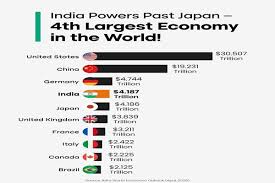
- In 2025, the NITI Aayog CEO, B.V.R. Subrahmanyam, stated that India has overtaken Japan to become the world’s 4th largest economy, citing IMF data.
- He projected that India could even surpass Germany within the next 2.5 to 3 years to become the 3rd largest economy.
- However, not everyone agrees on the ranking. Some analysts argue India may still be 5th currently, depending on how GDP is measured.
So, the claim is bold and largely based on nominal GDP (i.e. GDP measured in U.S. dollars at current exchange rates), which fluctuates with exchange rates.
2. India’s GDP: Past, Present & Projections
Here’s a simplified table to compare India’s GDP (in USD terms) and growth over time:
| Year / Period | India’s GDP (USD, approx) | Notes & Context |
|---|---|---|
| 2005 | ~ USD 0.8-1.1 trillion | India was much smaller on the global scale |
| 2015 | USD 2,103.6 billion | India was around USD 2.1 trillion in nominal GDP. |
| 2024 | ~ USD 3.9–4.0 trillion | India’s economy growing, narrowing gap with others. T |
| 2025 / FY 2025-26 (projected) | USD ~4.187 trillion | According to IMF projections used by NITI CEO to claim India edged past Japan. |
| 2027 (forecast) | ~ USD 4.601 trillion | Projection in a news PDF from NITI. |
Note: These figures are nominal, so movements in the INR–USD exchange rate, inflation, and how GDP is calculated matter a lot.
Growth Rates & Projections
- For FY2024-25, India’s GDP growth was estimated around 6.5% as per some sources.
- The IMF upgraded its forecast to 7% in FY24–25, with 6.5% for 2025.
- India’s longer-term trajectory, if sustained, could push it into the top 3 by late 2020s.
3. Competition: India vs Japan vs Germany
- Japan’s economy has stagnated or grown slowly in recent years. Declining demographics, lower productivity growth, and deflationary pressures have weighed.
- Germany, despite being a strong developed economy, is also facing headwinds from global trade slowdowns, energy costs, and supply chain constraints.
- India’s rising position is enabled by:
- A large, youthful population (demographic dividend).
- Strong domestic demand.
- Policy reforms, infrastructure investments, digital economy push.
- FDI and manufacturing initiatives (Make in India etc.).
Thus, while overtaking Japan is symbolic, India’s real competition is with Germany, and ultimately with the leaders (USA, China).
4. The Real Challenge: Jobs & Skills
Even though GDP numbers are rising, many Indians are still seeking meaningful employment. Without skilled people, economic growth may not translate into broad prosperity.
Why skill development matters:
- Mismatch in demand & supply: Many jobs today require digital, technical, or vocational skills—not just general education.
- Quality jobs: Growth alone doesn’t guarantee good-paying jobs; sectors like services, manufacturing and tech will demand skill.
- Inclusive growth: To reduce inequality and poverty, growth must spread to all states, rural areas, youth, women.
- Global competitiveness: To attract investments, India must produce a workforce ready for Industry 4.0 (AI, blockchain, robotics, biotech, etc.).
So, the economy’s success hinges not just on scale, but on the “human capital” behind it.
5. Future Outlook & What to Watch
- If India maintains growth of 6–7%+ annually, it may challenge Germany for the 3rd spot by 2027–2028.
- But risks loom: global recession, supply chain issues, inflation, currency depreciation, climate issues, policy missteps.
- India must focus on:
- Skill development (technical, vocational, digital) at scale.
- Strengthening state-level growth so all regions contribute.
- Infrastructure (energy, transport, telecom).
- Innovation, R&D, startups.
- Managing demographic pressures: urbanization, healthcare, social safety nets.
6. Opinion
This milestone of overtaking Japan should be celebrated—but it should also be a wake-up call. Numbers on paper mean little unless India’s youth are skilled, working, and participating in this growth. For India to truly transform, economic growth must become inclusive, sustainable, and skill-driven.
🎯 Suggested Interview Questions for NITI CEO Subrahmanyam
- Beyond the IMF data, what internal indicators support the claim that India has become the 4th largest economy?
- What steps is NITI Aayog prioritizing to ensure skill development keeps up with economic growth?
- How soon do you realistically expect India to overtake Germany for the 3rd position?
- In your view, which Indian states or sectors need the most push to balance growth across the country?
- What are the top risks you see that could derail this momentum (domestic or global)?
For more click: https://n-k.co.in/beldex-bdx-staking-on-aarman-how-it-works-rewards-and-investor-safety/