
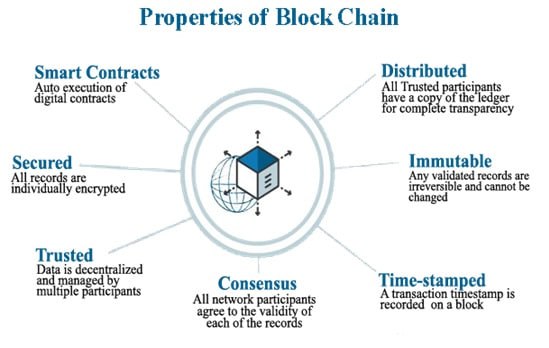
Blockchain is more than just a buzzword—it’s a digital revolution that has the power to transform how we store, share, and trust information. At its heart, blockchain works on some powerful properties that make it unique, reliable, and future-ready. Let’s explore these one by one.
🌟 Key Properties of Blockchain
| Property | What It Means (Simple Words) | Why It Matters | Example |
|---|---|---|---|
| Smart Contracts | Digital agreements that run automatically when conditions are met. | Removes middlemen, saves time, and reduces fraud. | Insurance claim automatically settled when hospital confirms treatment. |
| Secured | Data is encrypted (locked with codes). | Protects sensitive records from hackers. | Your medical history stored securely and only accessible by you. |
| Trusted | Managed by multiple participants (not one authority). | Prevents manipulation or bias. | Land registry records shared across government offices. |
| Consensus | Everyone in the network agrees before data is added. | Ensures fairness and accuracy. | Voting records validated by all participants before storing. |
| Distributed | Every participant has a copy of the ledger (database). | Increases transparency and prevents data loss. | Banks in a payment network share the same record. |
| Immutable | Once recorded, data cannot be changed or erased. | Prevents fraud and builds trust. | University degree certificates stored permanently on blockchain. |
| Time-stamped | Every transaction is recorded with time and date. | Easy to trace history of any record. | Tracking supply chain from farm to supermarket. |
🔄 Flow Diagram of Blockchain Properties
👉 Imagine it like a circle of trust:
Consensus ensures all agree → Secured locks the data → Distributed shares it everywhere → Immutable makes it permanent → Time-stamped adds history → Smart Contracts automate actions → Trusted keeps everything fair.
This cycle repeats every time new information is added, making blockchain stronger with each block.
💭 My Opinion
Blockchain is not just about cryptocurrency—it’s about building a trustworthy digital world. Today, we often depend on middlemen like banks, agencies, and brokers. But with blockchain, truth is coded and visible to all, not promised by a single authority.
This technology can help governments fight corruption, protect citizens’ rights, and even empower small businesses to compete globally. While challenges like regulation and awareness remain, blockchain is moving us toward a future of transparency and fairness.
“Blockchain is not just about money; it’s about building a future where trust is coded, not promised.”