
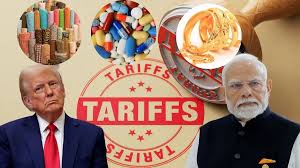
🌍 The Big News
On August 27, 2025, the United States suddenly increased tariffs (meaning: extra tax charged on goods when they are imported into a country) on Indian exports to 50%.
This is a huge jump and affects many sectors that have always powered India’s exports—like textiles, gems, jewelry, seafood, leather, furniture, and chemicals. Millions of Indian workers, especially those in MSMEs (Micro, Small, and Medium Enterprises), are directly linked to these industries.
Yes, this looks like a storm. But every storm also gives us a chance to build stronger ships.
⚠️ Who is Affected the Most?
- Textiles & Clothing – India exports clothes and fabrics worth billions to the U.S. With 60% tax now, many orders could stop. Cities like Tiruppur, Ludhiana, and Panipat may face job cuts.
- Gems & Jewelry – India’s diamonds and gold jewelry are loved worldwide. But now they face more than 50% tax, making them too expensive in the U.S. Surat and Mumbai could feel the pain.
- Seafood (Shrimp) – Around 40% of India’s seafood goes to the U.S. Higher tariffs mean our shrimp may lose out to cheaper competitors like Ecuador. Coastal communities may suffer.
- Leather, Furniture & Carpets – These are creative and skill-based industries. But 52% taxes will make them uncompetitive abroad.
- Chemicals, Machinery & Metals – Engineering goods, organic chemicals, steel, and aluminum will also lose their price advantage in the U.S.
👉 In simple words, exports worth billions of dollars and jobs of lakhs of Indians are under threat.
📉 Bigger Impact on India’s Economy
- Exports could fall by 40–70% in some sectors.
- India’s GDP (Gross Domestic Product = the total value of goods and services produced in the country) growth could slow down by almost 1%.
- The rupee has already weakened (₹88.3 per U.S. dollar).
Key Impacted Sectors
| Sector | Key Tariff Rate | Primary Concern |
|---|---|---|
| Textiles & Apparel | ~60% | Major export hub; high job risk |
| Gems & Jewellery | ~52–53% | Supply chain disruption, job loss |
| Seafood (Shrimp) | ~33% (plus duties) | Farmer distress, coastal employment hit |
| Machinery & Engineering Goods | ~51.3% | Uncompetitive pricing, manufacturing hit |
| Organic Chemicals | ~54% | Loss of price edge |
| Furniture, Bedding, Carpets | ~52–53% | Export collapse, emerging design setback |
| Metals (Steel/Aluminum/Copper) | ~51.7% | Supply chain & industrial pain |
| Pharmaceuticals, Electronics | Exempt | Still viable, but indirect impact possible |
How is India Responding?
The Indian government is not sitting quietly. Here are the steps being taken:
- Tax Relief & Support
- GST (Goods & Services Tax) cuts to reduce costs.
- Income tax relief of $12 billion announced to boost business confidence.
- Faster refunds for exporters and simpler trade rules.
- Help for Farmers & Cotton Sector
- The Cotton Corporation of India will buy more cotton at higher support prices so farmers don’t suffer.
- Import duty exemptions to stabilize prices.
- Diversifying Exports (Finding New Buyers)
- Pharma (medicines) and IT exports are being redirected to countries like Russia, Brazil, and the Netherlands.
- Tea and agriculture sectors are seeking subsidies and cheaper freight routes.
- Atmanirbhar Bharat Push (Self-Reliant India)
- Government and industries are working overtime to build stronger domestic markets and look for alternative export markets.
- Trade Minister Piyush Goyal has clearly said: “India will not bow down.”
- Invest in Skilling & Value Addition
Empower MSMEs with design, branding, tech adoption—so Indian goods evolve from “commodity” to “premium”—adding resilience amid global price wars. - Harness Strengthened Domestic Demand
With good monsoon yields, rural consumption is rising. The government could leverage this—for instance, incentivizing “make for India” textile clusters that serve both internal and alternative export channels.
My Opinion & Motivation
Yes, these tariffs are a setback. But history shows that India grows stronger under pressure.
Think about it—when the world closed its doors in the past, India created its own solutions. This is the time to:
- Strengthen Atmanirbhar Bharat (self-reliant India).
- Build better products, not just cheaper products.
- Explore new markets in Asia, Africa, Europe, and South America.
- Support MSMEs with technology, design, and branding so they can stand tall globally.
A challenge like this is not the end. It’s a wake-up call for India to rise, innovate, and lead. 🌟
This is not just about exports or imports. This is about India’s spirit. Every Indian can contribute—by supporting local industries, buying Indian goods, and believing in our capacity to adapt and win.
Sources to Verify Facts
- AP News – Trump’s tariffs on India
- Reuters – India eyes Russia, Brazil, Netherlands for pharma exports
- Times of India – Govt working with stakeholders
- Economic Times – Relief measures for exporters
- Financial Times – Rupee hits record low
For more information https://n-k.co.in/