
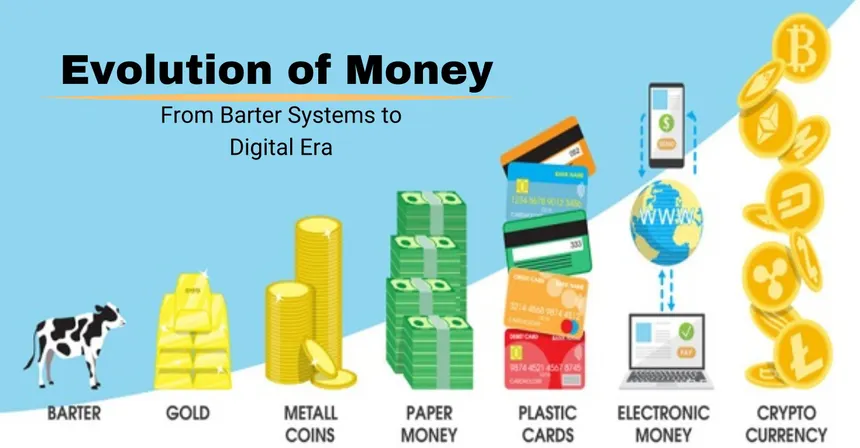
Money, as we know it today, has been on a fascinating journey. From simple trade of goods to digital assets like Crypto Coin, here’s how the world’s financial systems evolved over centuries.
🏹 Before 600 BCE – The Barter System
Long before coins or notes, people exchanged goods and services directly.
✅ A farmer gave wheat to a potter for clay pots.
✅ This system worked but was inefficient — what if the potter didn’t need wheat?
🏺 Around 600 BCE – Birth of Metal Coins
The first official coins are believed to have been minted in Lydia (modern-day Turkey).
✅ Coins made trade easier and carried value everyone trusted.
✅ Gold, silver, and copper coins spread across empires.
📜 7th Century (Tang Dynasty, China) – Paper Money
China introduced paper currency to reduce the burden of carrying heavy coins.
✅ This innovation soon spread across continents.
✅ Banks began issuing notes backed by reserves.
🏦 1600s–1800s – Rise of Modern Banking
European banks emerged, safeguarding wealth and issuing promissory notes.
✅ Trust in institutions grew.
✅ Paper notes became widespread.
💳 1950s – Credit Cards Revolutionize Spending
The first credit card (Diners Club, 1950) allowed people to buy now and pay later.
✅ By the 1970s, Visa and Mastercard made cards a global payment method.
🌐 1990s – Online Banking Arrives
With the internet boom, banks went digital.
✅ Customers could transfer funds, pay bills, and manage accounts online.
✅ It marked the beginning of 24×7 financial services.
📱 2010s – UPI and Mobile Payments
In 2016, India launched Unified Payments Interface (UPI):
✅ Instant bank‑to‑bank transfers via smartphones.
✅ Apps like Google Pay, PhonePe, and Paytm changed how we pay for everything.
₿ 2009 Onwards – Cryptocurrencies Enter
The mysterious Satoshi Nakamoto introduced Bitcoin in 2009:
✅ A decentralized digital currency, free from banks.
✅ Inspired thousands of projects — from Ethereum to Beldex, a privacy‑focused coin.
🔗 2020–2024 – Blockchain Adoption Accelerates
✅ Governments and enterprises started exploring blockchain in supply chain, healthcare, and legal records.
✅ Platforms like Aarman.com made staking accessible to newcomers.
✅ More people began earning passive income through Beldex staking and masternode hosting.
🚀 2025 – The Future Is Here
✅ Central Bank Digital Currencies (CBDCs) are rolling out globally, blending traditional finance with blockchain.
✅ Privacy‑oriented coins like Beldex are gaining traction as users demand control over their data.
✅ Staking ecosystems are maturing — platforms like Aarman are adding multi‑coin support and education tools.
✅ Entrepreneurs are launching tokenized startups, and smart contracts are automating agreements in supply chains and legal processes.
2025 marks a year where blockchain isn’t just a buzzword — it’s part of daily life.
My Views on the Journey of Money
Money is not just a medium of exchange — it’s the reflection of human progress.
I’ve always been fascinated by how our financial systems evolved, adapting to the needs of each generation. From the simplicity of barter to the complexity of blockchain, every step tells a story of innovation and trust.
Today, in 2025, we are witnessing another revolution — digital currencies, privacy‑focused coins like Beldex, and platforms like Aarman that empower individuals to earn through staking and participate in decentralized ecosystems.
It’s no longer just about transactions; it’s about freedom, security, and opportunities for everyone — from a small entrepreneur to a global enterprise.
I truly believe this journey is far from over, and those who learn and adapt will shape the future of finance.